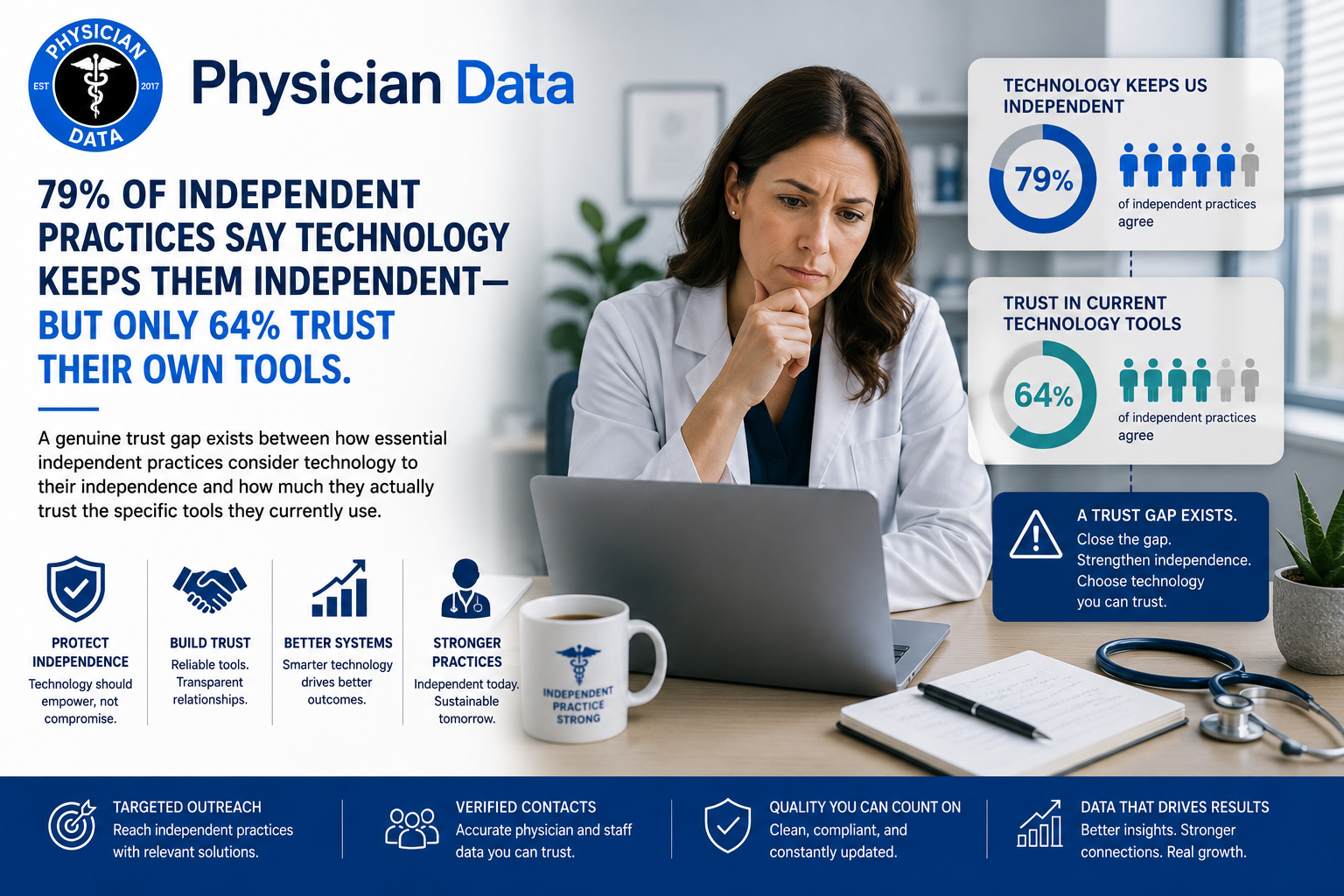


A genuinely significant trust gap deserves direct attention from independent practice leadership and the vendors serving this space. Seventy-nine percent of independent practice leaders say technology is what keeps them independent, yet only 64 percent trust the tools they already have, according to new industry research. This gap between technology's perceived strategic importance and practices' actual confidence in their current tools represents a genuine, practical problem worth understanding directly, both for practices evaluating their own technology strategy and for vendors seeking to close this trust gap effectively.
For independent practice administrators, this data validates what many have likely experienced directly: technology feels genuinely essential to maintaining independence, yet the specific tools currently deployed often fail to fully earn the confidence this strategic importance would suggest they deserve.
Independent practices have increasingly recognized technology as genuinely essential to competing effectively against larger, better-resourced health systems and hospital-employed practice models, since efficient technology infrastructure allows independent practices to operate leaner administrative structures while still delivering the kind of patient experience and operational efficiency larger organizations can achieve through scale alone. This genuine strategic recognition explains the high percentage of practices citing technology's importance to their continued independence.
The considerably lower trust percentage suggests genuine, persistent frustration with how currently deployed tools actually perform in daily practice operations, frustration that likely stems from tools that promise efficiency but deliver genuine operational friction, incomplete integration between different systems, or functionality that does not fully address the specific workflow challenges independent practices actually face in daily operations.
"Seventy-nine percent of independent practice leaders say technology is what keeps them independent. Only 64% trust the tools they already have."
A denied insurance claim still takes one to two weeks to reach the physician it actually belongs to in many current technology environments, a genuinely significant operational delay that illustrates precisely the kind of trust gap this data reflects. Technology that theoretically should surface this kind of critical information immediately, but instead requires this level of delay before reaching the physician who needs to act on it, represents exactly the gap between technology's strategic promise and its actual current performance many independent practices are experiencing directly.
This kind of specific operational friction, rather than technology failing outright, likely explains much of the trust gap this data reveals. Practices are not necessarily experiencing complete technology failures, but rather persistent friction and delay that falls meaningfully short of the seamless efficiency technology's strategic importance would suggest practices should be able to expect from their current tools.
Independent practices evaluating their current technology stack should recognize this trust gap as a genuine signal worth investigating specifically within their own operations, rather than assuming their own practice's experience is unique or that broader technology dissatisfaction reflects unavoidable friction inherent to healthcare technology generally. Practices experiencing this kind of gap between technology's strategic importance and their actual confidence in current tools have genuine reason to evaluate whether specific tools or workflows require meaningful reassessment, rather than accepting persistent friction as simply an unavoidable cost of maintaining independence.
This evaluation should focus specifically on identifying where the actual friction occurs, whether in claims processing delays, system integration gaps, or specific workflow inefficiencies, rather than assuming a wholesale technology replacement represents the only path toward closing this trust gap meaningfully.
Vendors serving independent practices should recognize this data as genuine, direct evidence that current market offerings are not fully earning practice trust despite practices' genuine recognition of technology's strategic importance to their continued independence. This represents both a genuine challenge and a real opportunity, since vendors who can meaningfully close this specific trust gap, through improved integration, faster claims processing visibility, or genuinely more reliable core functionality, are positioned to build considerably stronger practice relationships than vendors offering incremental feature additions without addressing the underlying trust and reliability concerns this data reveals.
Vendors should also recognize that practices' continued reliance on technology despite this trust gap reflects genuine strategic necessity rather than satisfaction, meaning practices actively evaluating alternative solutions represent a genuinely receptive audience for vendors who can credibly demonstrate meaningfully improved reliability and trust relative to practices' current experience.
Consider a solo practitioner whose practice management system technically handles insurance claims processing, appointment scheduling, and clinical documentation, appearing on paper to provide the comprehensive technology infrastructure independence requires. In daily practice, this same physician regularly discovers denied claims only after the standard follow-up window has already passed, since the system does not proactively surface denials requiring immediate attention, instead requiring manual, periodic checking that competes with the physician's actual clinical responsibilities throughout a busy patient care day.
This scenario illustrates precisely the gap this data reveals: the technology genuinely enables independence at a structural level, allowing this physician to avoid employment by a larger health system that might otherwise seem necessary to access comparable administrative infrastructure, while simultaneously failing to earn genuine trust because its actual daily performance falls meaningfully short of what proactive, reliable technology should deliver. This physician likely falls within the 79 percent recognizing technology's strategic importance while also falling within the 64 percent expressing limited trust in the specific tools currently available to actually deliver on that strategic promise reliably.
The specific example of denied claims taking one to two weeks to reach the responsible physician deserves particular attention, since claims processing delays carry direct, measurable financial consequences for independent practices operating with considerably less financial cushion than larger, better-capitalized health systems. A denied claim not addressed promptly risks missing appeal deadlines or requiring considerably more administrative effort to resolve once additional time has passed, meaning this specific kind of technology friction carries genuine financial stakes beyond simple operational inconvenience.
Practices evaluating their own technology stack should specifically assess how effectively their current systems surface claims requiring attention, rather than assuming general system functionality adequately addresses this specific, financially consequential workflow. This kind of targeted evaluation, focusing on specific high-stakes workflows rather than general technology satisfaction, likely identifies more actionable improvement opportunities than a broad assessment of overall system satisfaction alone.
This dynamic, institutions recognizing a genuine gap between a resource's strategic importance and their actual confidence in it, is showing up across sectors this year. K-12 districts can find useful grounding directly too, since K12 Data's FAQ page addresses many of the same underlying data quality questions. Higher education can find useful grounding directly too, since College Data's FAQ page addresses many of the same underlying data quality and sourcing questions.
Government agencies are managing a related compliance scramble too, since state legislatures passing thousands of new technology bills this year have created a patchwork most local governments were not staffed to handle. And K-12 hiring reflects a related structural pressure too, since Indiana's elimination of teacher preparation programs under a state productivity mandate is forcing districts to reconsider settled hiring assumptions.
The gap between how many independent practices consider technology essential to their independence and how many actually trust their current tools represents a genuine, actionable signal worth understanding directly. Practices investigating this gap within their own specific operations, and vendors genuinely committed to closing it through improved reliability and integration, are positioned to navigate this moment considerably more effectively than those treating persistent technology friction as simply an unavoidable cost of doing business.
Ready to reach the independent practice administrators navigating this technology trust gap? Build a physician marketing database, or buy a physician email list, with Physician Data today.




 0
0
POST A COMMENT