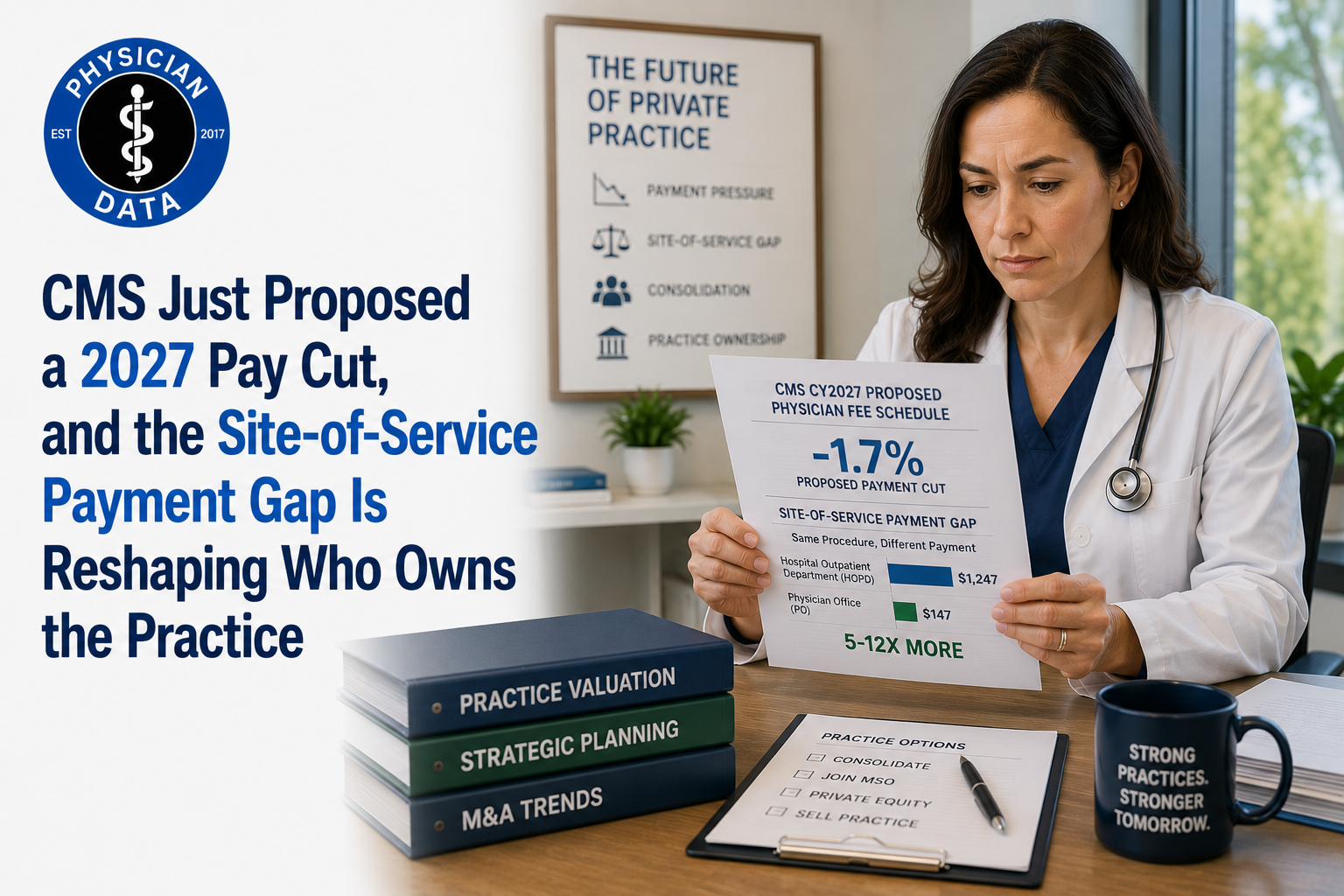


Medicare just told physicians they are getting paid less next year, and the math behind why a practice sells to a hospital system versus stays independent just got a lot more urgent. CMS released its calendar year 2027 Physician Fee Schedule proposed rule this month, and it includes a 1.7 percent cut to physician reimbursement along with reduced payment for procedures performed on the same day. That lands directly on top of a temporary 2026 raise and a stalled congressional fix that were already squeezing practice economics heading into 2027.
Layer on top of that a payment gap that has quietly become one of the biggest forces reshaping who owns a medical practice: the same low-risk procedure can pay five to twelve times more when performed in a hospital outpatient department than in an independent physician's office. That gap is not new, but it is now colliding with a fresh reimbursement cut at exactly the moment independent practices are weighing whether they can survive without hospital or private equity backing, and the decisions being made this year will shape practice ownership across entire specialties for a decade or more.
The site-of-service payment differential exists because Medicare and many commercial payers reimburse hospital outpatient departments at a facility rate on top of the physician's professional fee, while an independent office only bills the professional fee. For years this gap has quietly incentivized health systems to acquire independent practices and convert them into hospital outpatient departments, instantly increasing reimbursement for the exact same procedure performed by the exact same physician in the exact same building, simply by changing who bills for it.
A federal bill aimed at closing this gap has been introduced, and patient advocacy groups have been vocal about what the differential does to recruiting, referral patterns, and patient choice, since patients often have no idea the same colonoscopy or minor procedure costs dramatically more once a practice becomes hospital-owned. Whether or not that legislation moves, the gap itself is already the single biggest financial lever driving practice acquisition conversations happening in board rooms and physician lounges right now.
A 1.7 percent proposed cut sounds modest in isolation, but it lands on practices that are already running thin margins after a temporary 2026 raise expires and a permanent legislative fix remains stalled in Congress. For an independent practice weighing whether to stay independent, sell to a hospital system, sell to private equity, or join a management services organization, a Medicare rate cut is not an abstract policy detail. It is a direct hit to the number the practice's accountant is running through a valuation model this quarter.
Healthcare investment bankers advising on these deals are already framing 2026 and 2027 as a pivotal window, since a practice's value calculation depends heavily on trailing and projected reimbursement, and a confirmed rate cut changes that projection in ways that make some deals more attractive to sign now, before the cut takes effect, rather than waiting and negotiating from a weaker position later.
This is not a decision physicians are making alone. Independent practice owners are consulting healthcare-focused investment bankers, MSO executives, and private equity representatives simultaneously, often for the first time, to understand what their practice is actually worth under each ownership scenario. MSO executives in particular are emerging as one of the most consequential and least understood buyers in this market, since a single MSO relationship can influence purchasing and staffing decisions across dozens or hundreds of affiliated practices at once.
Hospital system executives evaluating acquisition targets are running the same site-of-service math in reverse, calculating exactly how much reimbursement increases once an acquired practice converts to hospital outpatient billing, which makes certain specialties and geographic markets far more attractive acquisition targets than others depending on how wide the local payment gap runs. Markets where commercial payer contracts already reimburse hospital outpatient departments generously are seeing the most aggressive acquisition activity, since the return on converting an acquired practice's billing structure is highest there.
Same-day procedure specialties, including gastroenterology, ophthalmology, dermatology, and orthopedics, are facing this pressure hardest, since same-day procedure reimbursement is a specific target of the proposed 2027 cut and these specialties also tend to have the widest site-of-service payment gaps. A gastroenterologist running a busy independent endoscopy practice is looking at a materially different financial picture under hospital ownership than under continued independence, and that gap is only growing as the proposed cut compounds against an already-thin margin, forcing a decision timeline that used to unfold over years into a matter of a few quarters.
Primary care physicians, by contrast, are facing a somewhat different calculation, since primary care visits carry a smaller site-of-service differential but face their own margin pressure from rising overhead and administrative burden. This means outreach to physicians about practice valuation, MSO partnership, or acquisition readiness needs to be segmented by specialty, not treated as a single undifferentiated physician audience, since a gastroenterologist and a primary care physician are living through genuinely different versions of this same broader story.
Vendors selling practice valuation services, MSO partnership platforms, revenue cycle management tools, or acquisition advisory services have a direct, urgent story to tell physicians and practice administrators facing this decision right now, not in some hypothetical future planning cycle. The proposed rule is open for public comment, which means the exact final numbers are not yet locked in, but the direction is clear enough that practices are already modeling scenarios and having real conversations with advisors. Practice administrators who wait for the final rule before acting are, in many cases, already behind competitors in their own specialty and geographic market who started planning the moment the proposed rule was published.
This is exactly the kind of moment where accurate, current physician contact data matters most. A practice actively evaluating a sale or MSO partnership is not a static target that will still be there in the same ownership structure a year from now. Reaching the right physician or practice administrator during this specific decision window, before the practice's ownership question is settled, is worth considerably more than reaching them after the decision has already been made and the relationship with a new owner has already been established. Once a practice signs with an MSO or a hospital system, the vendor relationships that come with that new ownership structure are often already decided, and an outside vendor arriving after the fact is starting from a much weaker position than one who reached the practice while the decision was still genuinely open.
This reimbursement squeeze is not happening in isolation from the broader administrative burden independent practices already carry. Prior authorization alone drains roughly thirteen hours a week from the average practice, time that translates directly into staff cost and physician frustration that makes hospital or MSO employment look more appealing simply because someone else absorbs that administrative overhead. A practice weighing independence against acquisition is not just running a reimbursement calculation. It is weighing the cumulative weight of administrative burden, staffing cost, and now a confirmed rate cut, all at the same time.
Vendors selling practice efficiency tools, prior authorization automation, or administrative outsourcing services have an unusually strong complementary pitch to make right alongside the reimbursement conversation, since a practice that can meaningfully reduce its administrative burden changes its own independence calculation without needing to sell to anyone. This is a genuinely different value proposition than a pure valuation or MSO partnership pitch, and it deserves its own outreach segment rather than being folded into a generic practice management pitch.
On top of the federal reimbursement picture, states are beginning to intervene directly in how payers handle physician billing. Some states have already moved to limit AI-driven downcoding of physician claims, a practice where insurers use automated systems to reduce reimbursement on submitted claims without meaningful human review. This state-level activity is a second, parallel front in the same broader fight over physician reimbursement, and it means practice administrators evaluating their financial position have to track both federal rate changes and an increasingly active patchwork of state payer regulation simultaneously.
This is exactly the kind of compounding complexity that makes generic, one-size-fits-all vendor outreach fall flat. A practice in a state actively limiting AI downcoding is facing a meaningfully different payer landscape than a practice in a state where insurers still operate with fewer restrictions, and outreach that acknowledges this state-level variation reads as far more credible than a pitch that treats reimbursement pressure as a single uniform national story.
Private equity and management services organizations that have spent the last several years aggressively acquiring physician practices are recalibrating their own models in response to this same reimbursement pressure. A confirmed rate cut changes the return profile on recent and pending acquisitions, and sophisticated buyers are adjusting valuation multiples accordingly, sometimes offering less for the same practice than they would have a year ago, even as the strategic logic of consolidation remains intact.
This creates a genuinely two-sided market dynamic worth understanding. Independent practices facing this pressure may be more motivated to sell than they were a year ago, but the buyers on the other side of that table are simultaneously recalibrating what they are willing to pay, which means the negotiating dynamic in 2026 and 2027 looks different than it did during the more aggressive consolidation wave of recent years. Vendors advising on these transactions need to understand both sides of that shifting calculus to be genuinely useful to either party.
A federal bill shifting compliance authority from Washington to the states is forcing K-12 districts into rapid organizational decisions in a compressed window, much like physician practices facing this same compressed reimbursement decision timeline right now. State and local governments are navigating an equally fast-moving disruption of their own, since new state-level restrictions on large data centers are creating entirely new categories of government decision-makers that barely existed a year ago. And K-12 hiring platforms are watching a parallel financing squeeze unfold too, since the same federal loan changes reshaping graduate borrowing broadly are also threatening the teacher pipeline at exactly the wrong moment for districts already short hundreds of thousands of certified teachers. And higher education institutions are navigating their own version of a hard financial ceiling, since new federal borrowing caps just eliminated the flexible financing graduate programs relied on for years, forcing pricing and enrollment decisions on a timeline nobody chose voluntarily.
CMS's proposed 2027 fee schedule cut did not create the site-of-service payment gap, but it is compressing the timeline on decisions practices were already facing. Independent physicians, MSO executives, and hospital system leadership are actively working through practice ownership and acquisition decisions right now, not on some future planning horizon, and vendors who can reach them accurately during this specific window are stepping into conversations that are already happening, whether or not a given vendor has noticed yet.
Ready to reach the physicians and practice leaders navigating this decision right now? Build a physician marketing database, or buy a physician email list, with Physician Data today.
K12 Data — Build a List | Pricing | Blog College Data — Build a List | Pricing | Blog Physician Data — Build a List | Blog Civic Data — Build a List | Blog K12 Talent — Post a Job | Search Jobs | Blog




 0
0
POST A COMMENT