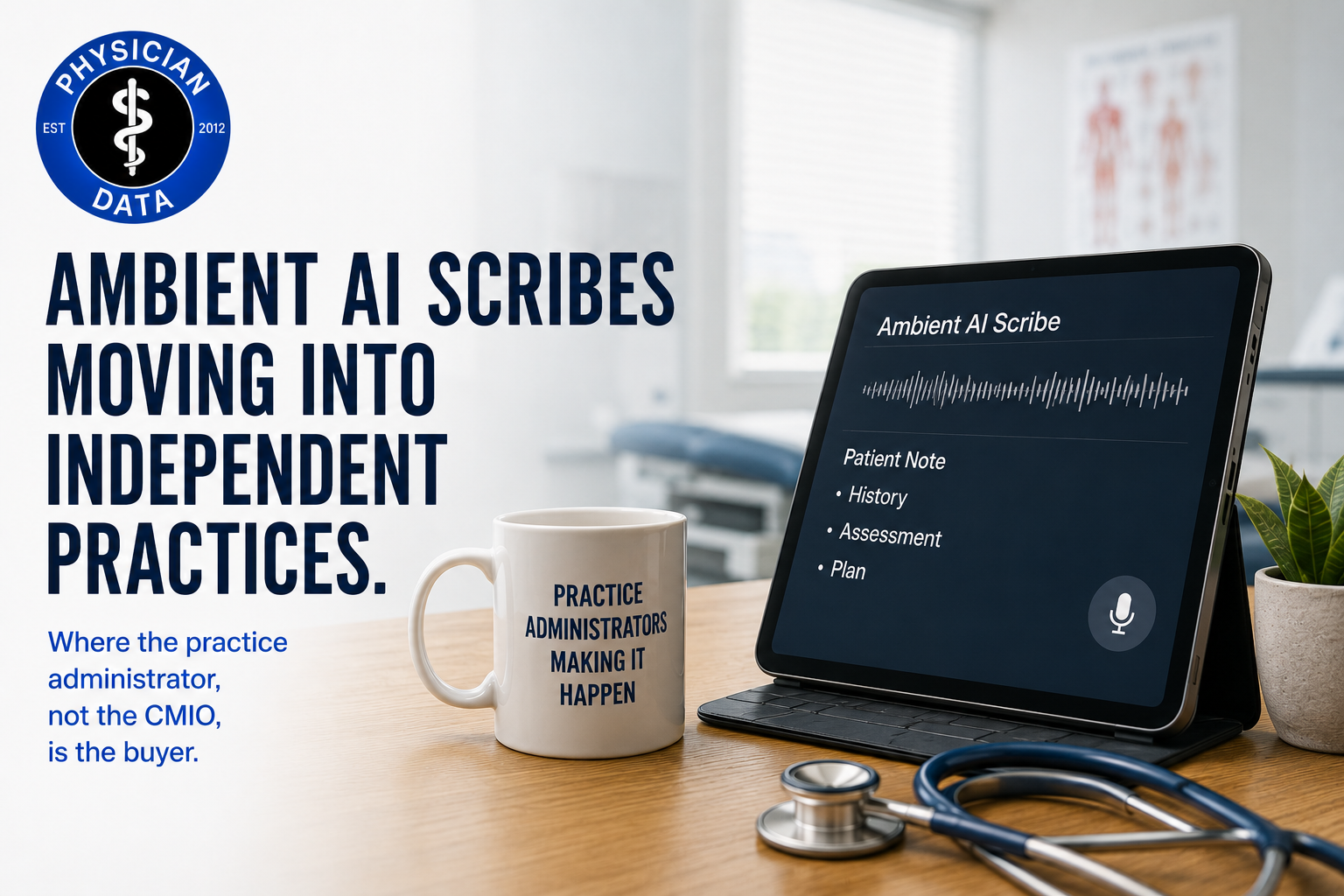


Ambient AI Scribes Have Reached the Independent Practice, and the Buyer Isn't Who You'd Expect
As recently as 2023, ambient AI scribes were a pilot-program curiosity confined mostly to a handful of academic medical centers with the IT staff and capital budgets to run a careful evaluation. That window closed fast. As of 2026, seventy percent of physicians in the UCSF health system use an AI scribe in daily practice. Kaiser Permanente's Permanente Medical Group logged more than 2.5 million ambient AI encounters across 7,260 physicians over fourteen months, saving an estimated 15,700 hours of documentation time. Cleveland Clinic had more than 4,000 of 6,000 eligible physicians actively using the technology within fifteen weeks of launch. The American Medical Association found 66 percent of physicians using some form of AI in practice by 2024, up from 38 percent the year before, and industry analysts project the U.S. AI medical scribing market to grow from roughly $397 million in 2024 to nearly $3 billion by 2033.
What almost none of that coverage addresses is what happens once this technology moves past the large health system and reaches the independent and small-group practice, which is exactly where it is headed next, and where the buyer is a fundamentally different person than the CMIO or informatics team most physician mailing lists are built to reach.
The clinical case for ambient AI scribes is no longer built on enthusiasm alone. A landmark randomized trial published in NEJM AI and run across UCLA found both DAX Copilot and Nabla significantly reduced documentation time and improved clinician wellness measures across all fourteen specialties tested, the first large-scale, multi-specialty randomized evidence of its kind. A separate five-site study across Mass General Brigham, Emory, UCSF, UC Davis, and Yale New Haven examined more than 8,500 clinicians and found AI scribe adopters spent 13.4 fewer minutes on total EHR time and 16 fewer minutes on documentation per eight-hour clinical day, along with a 1.7 percent increase in weekly visit volume that translated to a conservatively estimated $167 in additional monthly evaluation and management revenue per clinician. Documentation burden is cited by 16 percent of providers as their single largest driver of burnout, which makes this one of the highest-return technology categories a practice can adopt right now.
At a large health system, an ambient AI scribe purchase moves through a formal evaluation involving the CMIO, the IT security team, EHR integration specialists, and a compliance review before a single clinician ever tries the product. At an independent practice or small group, most of that structure simply does not exist. The practice administrator, or in many solo and small-group settings the physician owner directly, is the entire purchasing committee, and the decision often gets made after a single demo and a short trial period rather than a formal RFP process.
Pricing has stratified in a way that matches this buyer's reality. Budget self-serve tools now start as low as $40 per clinician per month with free tiers available for the lightest users. Mid-range products such as Nabla run upward of $100 per month per clinician. Enterprise platforms with deep EHR integration, including Microsoft's Dragon Copilot and Abridge, run several hundred dollars per clinician per month and typically favor multi-year contracts that make far more sense for a large system than a two-physician practice. The market has also started building lower-friction options specifically for independent practices: athenahealth now offers its athenaAmbient tool free to customers, Epic announced its own AI Charting feature in February 2026, and Doximity offers a free scribe tool to verified U.S. clinicians, all of which lower the adoption barrier for exactly the practice segment large enterprise vendors have historically ignored.
Adoption is not evenly distributed across specialties, and understanding where it concentrates matters for anyone trying to prioritize outreach. Kaiser Permanente's data found that the heaviest-documenting specialties, mental health, primary care, and emergency medicine, saw the highest uptake regardless of a clinician's age or years in practice, which cuts against the assumption that younger physicians are driving this adoption wave. That pattern holds particular relevance for independent practice, since primary care and mental health are exactly the specialties most likely to operate as small, independent groups rather than large hospital-affiliated systems. A behavioral health practice with three clinicians and no dedicated administrative staff has just as much documentation burden per patient encounter as a twenty-physician group, and often less capacity to absorb it, which makes this exact segment a disproportionately strong early-adopter audience for a self-serve or low-cost ambient AI product.
Malpractice carriers have started weighing in directly on ambient AI adoption, and the guidance so far is notably measured rather than alarmist. Richard Anderson, chairman and CEO of The Doctors Company, has noted that physicians using sophisticated ambient listening tools are generally quite pleased with them, while also flagging the underlying irony that a technology-driven documentation problem is now being solved with more technology. The core risk independent practices are being advised to manage is straightforward: disable auto-accept features and require active physician review of every AI-drafted note before it enters the chart, rather than treating the draft as a finished product. This is a genuine differentiator vendors can lead with in a sales conversation, since a practice administrator evaluating multiple products is increasingly asking about review workflow and audit trail features specifically, not just transcription accuracy.
In practices without a dedicated IT or informatics staff, the practice administrator is typically the person who researches, trials, and ultimately signs off on ambient AI scribe technology, reporting directly to the physician owner rather than through a multi-layered health system approval chain. This is the single highest-value contact this technology category has for reaching the independent practice market at scale.
Particularly in direct primary care and other independent practice models built around a smaller patient panel, the physician owner is directly evaluating documentation technology as both a clinical tool and a business decision, since after-hours charting time has a direct, personal cost to a physician who does not have a large support staff absorbing that burden.
Because many independent practices already have a relationship with a practice management or billing software vendor, partnership and integration channels through those existing vendor relationships are an increasingly effective way to reach this buyer without a direct sales motion.
The documentation burden driving this adoption wave is the same category of workforce pressure K12 Data has documented pushing districts toward the four-day school week as a retention strategy, a parallel response to a labor force that is increasingly willing to change how it works rather than accept administrative burden as fixed. The workforce training this technology requires connects directly to the graduate and professional program enrollment growth College Data has tracked in health informatics and healthcare administration programs, which are training the practice administrators now making these purchasing decisions. The governance and data privacy questions ambient AI raises for patient conversations sit squarely inside the kind of state-level regulatory activity Civic Data tracks across other public-sector technology categories. And the specialized new roles emerging around AI governance and clinical documentation integrity inside larger practices and health systems are exactly the newly created position type that K12 Talent's research on administrative hiring for newly created roles has documented across other sectors facing the same structural shift.
● Build practice administrator and office manager into your physician mailing list as a distinct, high-priority contact for documentation technology, separate from your existing physician and CMIO contacts.
● Segment independent and small-group practices as a distinct buyer category with a faster sales cycle and lower price sensitivity for self-serve tiers, rather than running the same enterprise sales motion built for hospital systems.
● Track free and low-cost entry points from athenahealth, Epic, and Doximity as a signal of where competitive pressure is pushing pricing, since independent practices are highly price-sensitive to this specific category.
● Watch specialty-level adoption data closely, since primary care, mental health, and emergency medicine are consistently the heaviest-documenting specialties and the highest-value early adopters for any new documentation technology entering this market.
The competitive dynamics in this market are shifting fast in ways that specifically favor the independent practice buyer. Doximity's decision to offer a free AI scribe to verified clinicians has begun commoditizing basic transcription, pushing vendor differentiation toward what happens after the transcript is generated, structured coding support, problem list accuracy, and integration depth, rather than the core listen-and-write function itself. That commoditization at the entry level is good news for a two-physician practice that simply wants documentation relief without a five-figure annual contract, and it means the next twelve months are likely to bring more free and near-free entry points into this category, not fewer. Practices that adopt early and build the workflow discipline of reviewing every draft note before it enters the chart are positioning themselves well regardless of which specific vendor they end up using long term, since switching between ambient AI platforms has proven to be a relatively low-friction transition for practices that have already built strong review habits around the technology.
Ambient AI scribe adoption crossed from pilot program to mainstream expectation faster than almost any physician-facing technology in recent memory, and the next wave of growth is happening in independent and small-group practices where the CMIO does not exist and the practice administrator or owner physician makes the call directly. Vendors who have built this contact into their physician mailing list are reaching a genuinely underserved buyer with real purchasing authority and a short sales cycle. Vendors still routing every conversation through hospital system informatics contacts are missing where this market is actually headed next.
K12 Data -- Build a List | Pricing | Blog College Data -- Build a List | Pricing | Blog Physician Data -- Build a List | Blog Civic Data -- Build a List | Blog K12 Talent -- Post a Job | Search Jobs | Blog




 0
0
POST A COMMENT