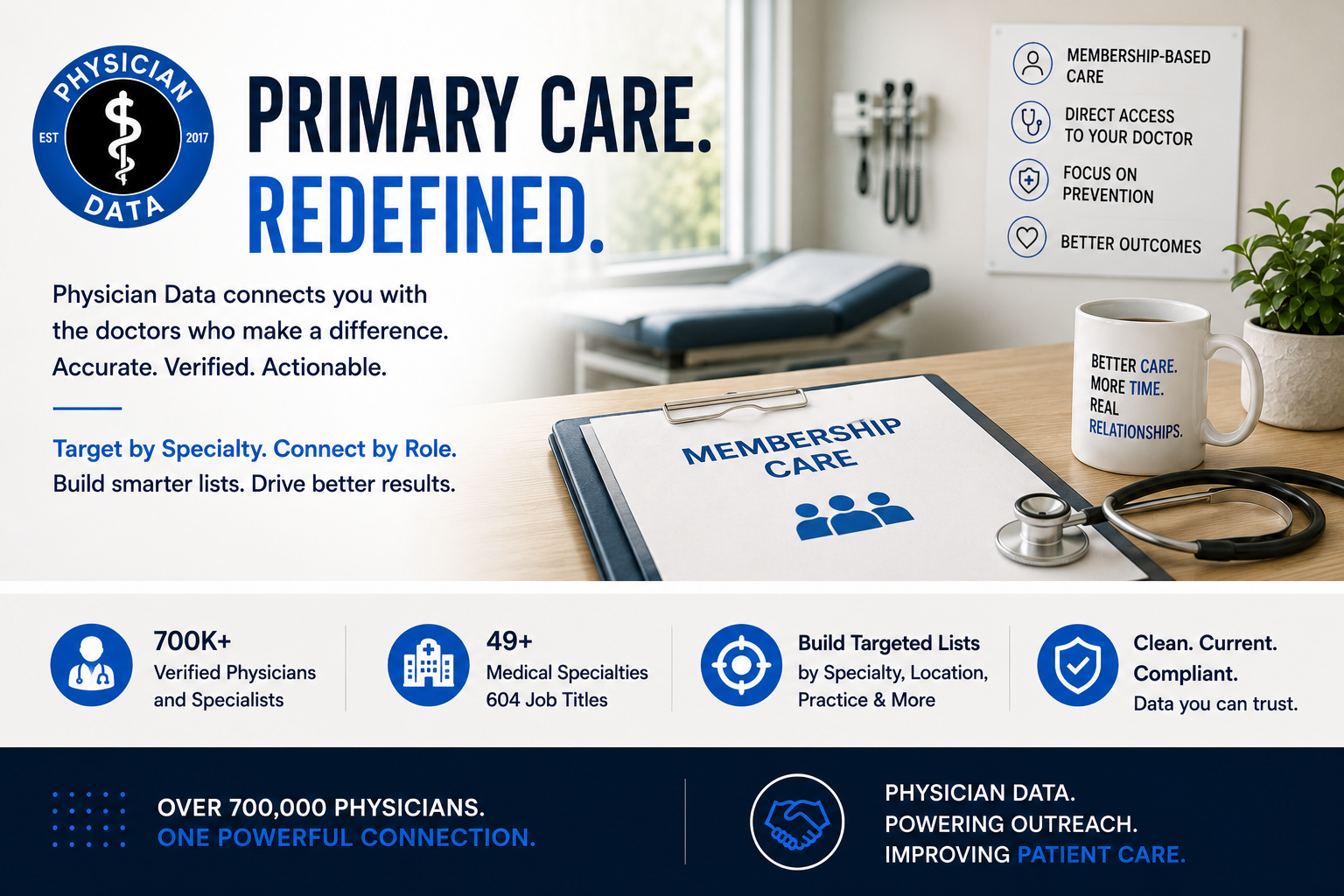


Direct primary care -- the practice model where patients pay a monthly or annual membership fee directly to a physician practice in exchange for unrestricted primary care access, with no insurance billing involved at all -- was, a decade ago, a fringe idea championed by a relatively small number of physicians frustrated with insurance-based primary care.
It is no longer fringe. Direct primary care has grown from a few hundred practices nationally a decade ago to several thousand practices today. It has matured into a genuine, distinct practice model with its own corresponding technology ecosystem -- one that most physician mailing lists have never carved out as a category distinct from traditional insurance-based primary care.
Independent physician practice ownership has fallen from roughly 60 percent of all physicians fifteen years ago to under 30 percent today, driven substantially by administrative burden and reimbursement pressure. Direct primary care represents one of the most complete responses available to a physician who wants to remain independent while genuinely escaping that burden.
A direct primary care physician can typically manage a panel of 600 to 800 patients rather than the 2,000 to 2,500 patient panel a traditional insurance-based primary care physician manages to remain financially viable.
Direct primary care practices need billing and payment infrastructure built around recurring membership fees rather than per-visit insurance claims -- a fundamentally different technology requirement than the claims-based billing systems that dominate traditional primary care practice management. Subscription billing platforms that manage membership tiers, family plan structures, payment processing, and the member retention and renewal workflows that determine a direct primary care practice's financial sustainability are a foundational and currently underserved technology category for this market. Most mainstream practice management software simply was not built with a recurring membership model in mind, which has created genuine demand for a category of billing technology that did not need to exist a decade ago.
The direct primary care value proposition depends heavily on patient access and communication that goes beyond what traditional primary care typically offers -- direct messaging with the physician, same-day appointment scheduling, and the kind of ongoing relationship management that a 600-patient panel makes operationally possible in a way a 2,500-patient panel does not. Patient communication and engagement platforms built specifically for this high-touch, membership-based relationship model are a distinct purchasing category from the patient portal technology built for standard insurance-based primary care, where the communication volume and relationship intensity assumptions are entirely different.
Traditional primary care practice management software is built around optimizing visit volume and claims throughput, because visit volume and claims reimbursement are what determine a traditional practice's revenue. Direct primary care practice management software needs to optimize around panel size, member retention, and the recurring revenue model that membership fees create -- a genuinely different operational logic that most mainstream practice management platforms were not originally designed to support, creating real and growing demand for direct primary care-specific alternatives built from the ground up around the membership model rather than retrofitted from a claims-based system.
Direct primary care practices are overwhelmingly solo or small-group practices, which means the practice owner -- typically a physician -- is directly evaluating and purchasing the membership billing, communication, and panel management technology the practice requires, without the multi-layered administrative structure that a larger health system or PE-backed group would have. This concentrated decision-making authority means a single conversation with a direct primary care practice owner is frequently the entire purchasing committee, which is a meaningfully different and faster sales dynamic than most other physician practice categories where multiple stakeholders need to sign off before a technology decision moves forward.
Organizations like the Direct Primary Care Coalition and various state and regional DPC physician associations are increasingly influential in this market, serving as both advocacy organizations and informal technology and best-practice clearinghouses for member practices. A vendor relationship with these coalition and association leaders can provide access to and credibility with a meaningful share of the entire direct primary care physician population through a single relationship, in much the same way that a relationship with an Independent Practice Association can multiply a vendor's reach across dozens of affiliated independent practices simultaneously.
The K-12 and government parallels to this practice-model shift are worth noting. Just as direct primary care physicians are restructuring their practice model to escape administrative burden, K12 Data's research on the four-day school week documents districts restructuring their entire operating calendar to address a comparable workforce retention pressure, and Civic Data's research on short-term rental regulation documents local governments building entirely new administrative functions from scratch. In all three cases, a structural pressure is producing a genuinely new operational model with its own distinct technology requirements that most contact databases have not yet caught up to.
• Add direct primary care as a distinct practice model classification, separate from general primary care or family medicine specialty classifications.
• Segment by panel size as a proxy for practice model, since the 600-to-800-patient panel is itself a strong signal of practice type.
• Map direct primary care coalition and association leadership as a multiplying contact whose influence extends across a meaningful share of the practice population.
• Recognize that direct primary care practice owners are frequently the sole purchasing decision-maker, which means sales cycles for this segment move faster.
Hiring for a growing direct primary care practice is itself a distinct recruiting challenge, similar in kind to the specialized administrative hiring documented in K12 Talent's research on how districts hire for newly created roles. A growing DPC practice is frequently hiring for a role its existing staff has never filled before, the same dynamic K12 Talent has documented in education administrative hiring.
• Add direct primary care as a standalone practice model field in your contact database build process, rather than treating it as a sub-variant of general primary care that gets folded into the same outreach as a traditional insurance-based practice.
• Build a sales motion specifically for this segment that reflects the single-decision-maker reality of most direct primary care practices, since the multi-stakeholder, multi-touch sales process built for larger organizations will feel slow and mismatched to a DPC practice owner who can say yes or no in a single conversation.
• Engage directly with state and regional DPC physician associations as a force-multiplying relationship that extends your reach across the practice population far more efficiently than individual practice-by-practice outreach.
Direct primary care is no longer a fringe experiment that a small number of idealistic physicians have chosen to pursue. It is a genuine, growing practice model with several thousand practices nationally and its own distinct and currently underserved technology ecosystem -- membership billing, panel-based practice management, and high-touch patient communication tools that most mainstream healthcare technology vendors and most physician mailing lists have never specifically built out as their own category. The vendors who recognize direct primary care as a distinct physician segment, with its own buyer map and its own technology requirements, are positioned to serve a fast-growing market that most of their competitors are still lumping in with traditional primary care, and that will only become harder to ignore as the practice count continues its decade-long climb.
K12 Data -- Build a List | Pricing | Blog College Data -- Build a List | Pricing | Blog Physician Data -- Build a List | Blog Civic Data -- Build a List | Blog K12 Talent -- Post a Job | Search Jobs | Blog




 0
0
POST A COMMENT