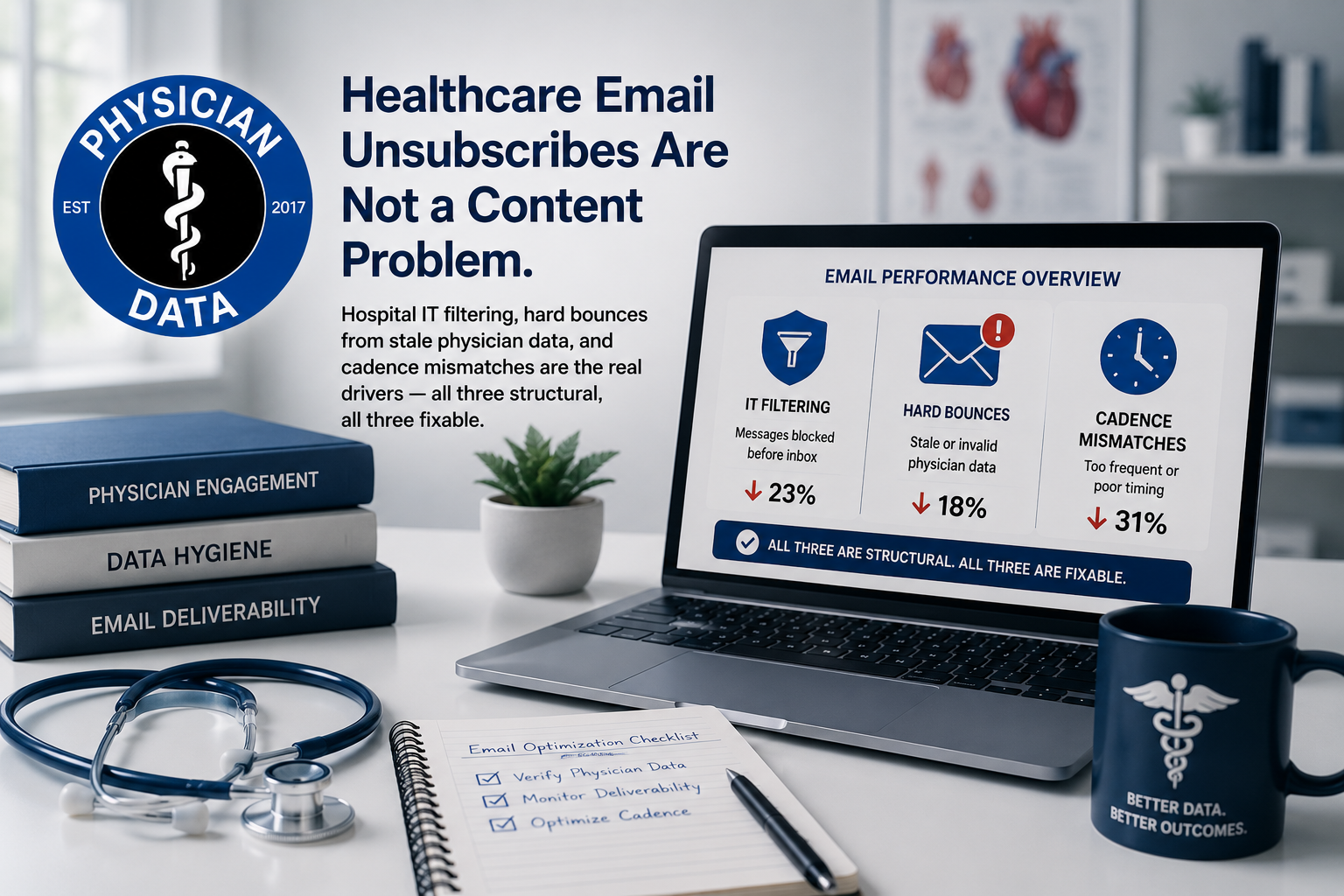


Healthcare and physician email lists have a reputation in B2B marketing circles for being the most difficult to work with. High unsubscribe rates. High complaint rates. Hard bounce rates that damage sender reputation more aggressively than in most other verticals. Low engagement metrics that make campaign ROI hard to justify. Conventional wisdom attributes this to physicians being busy, getting too much email, and being generally unreceptive to vendor outreach.
The conventional wisdom is not entirely wrong, but it is significantly incomplete. The structural reasons that healthcare email marketing underperforms other B2B verticals are more specific and more fixable than the "physicians are too busy" explanation suggests -- and understanding them is the difference between a physician mailing list that consistently underperforms and one that generates genuine, measurable pipeline for healthcare technology vendors.
The most common error in physician email marketing is using work email addresses as the primary contact channel for a physician audience. Hospital and health system IT departments are among the most aggressively configured email security environments in any sector -- for legitimate patient safety and HIPAA compliance reasons, hospital IT systems apply filtering logic that is designed to catch potentially dangerous emails before they reach clinical staff who are focused on patient care. The collateral effect of this security orientation is that vendor marketing email -- even legitimately sent, properly authenticated, genuinely relevant marketing email -- is frequently filtered, quarantined, or blocked at hospital IT systems before the physician ever sees it.
The specific filtering behaviors vary by institution, but the pattern is consistent: vendor email sent to hospital-domain addresses faces a significantly higher barrier to inbox placement than vendor email sent to personal professional addresses or to practice-based addresses at smaller physician practices without hospital-level IT infrastructure. Vendors who have built their physician contact database exclusively around hospital-domain work addresses are fighting an inbox placement battle that their technical sending infrastructure cannot win regardless of how well-configured it is, because the filtering decisions are being made at the institutional level by IT policies that exist for security reasons that have nothing to do with the vendor email being sent.
Physician career mobility is higher than most vendor contact databases adequately account for. Physicians join and leave practices, move between hospital affiliations, complete fellowships and relocate, and retire at rates that produce meaningful contact data staleness within twelve to eighteen months of a database being built. A physician email list that was accurate when it was purchased may have a meaningfully different accuracy profile twelve months later -- and the physician contacts that have changed affiliation or retired generate hard bounces that damage sender reputation with every campaign send.
The reputation damage from hard bounces is cumulative and slow to recover. A sending domain that generates hard bounces at a rate above two to three percent over a sequence of campaigns will see progressively worse inbox placement across the board -- not just at the domains where the hard bounces occurred, but at all receiving domains that share reputation intelligence through blocklist services and email provider reputation networks. A physician mailing list that is not being continuously verified and updated is not just a list quality problem. It is a sender reputation liability that affects every campaign sent from the same domain.
Physicians are measurably more sensitive to email volume and frequency than most other B2B audiences, for reasons that are entirely understandable given the intensity and stakes of their professional environment. The research on physician communication preferences consistently finds that physicians respond better to less frequent, higher-quality, more genuinely relevant outreach than to the higher-frequency drip campaign cadences that are standard in many B2B marketing playbooks. A weekly touchpoint sequence that might be appropriate for a software company targeting enterprise IT buyers is experienced as intrusive and irrelevant by a physician audience, and it produces unsubscribe rates that reflect that mismatch rather than any specific problem with the content.
The physician email engagement preferences parallel what we see in other high-stakes professional audiences. The government official email timing research documented in Civic Data's email marketing analysis shows similar patterns -- officials who are managing complex, high-stakes decisions respond better to infrequent, precisely timed, high-value outreach than to regular cadence campaigns that create inbox noise without adding value. And the K-12 contact tier timing research documented in K12 Data's back-to-school email analysis shows the same specificity requirement -- the right message, at the right moment, to the right role produces ROI; the same message at the wrong moment or to the wrong role produces unsubscribes.
The highest-performing healthcare email campaigns are built around contact segmentation that reflects the actual clinical and organizational reality of the physician audience rather than generic specialty and geography filters. A campaign targeting independent primary care physicians in practices of five or fewer physicians -- who have the most acute administrative burden and the most direct purchasing authority for the technology that addresses it -- is a fundamentally different campaign from one targeting primary care physicians broadly. The segmentation that produces the highest engagement is the segmentation that is most specific to the purchasing context the vendor is addressing: practice size, practice model (independent versus health system affiliated versus concierge or direct primary care), specialty, and the specific administrative challenge that the vendor's product addresses.
Vendors who have built physician contact databases that include personal professional email addresses -- email addresses that physicians use for professional correspondence outside their hospital or practice system -- consistently report better inbox placement, higher open rates, and lower unsubscribe rates than vendors relying exclusively on hospital-domain work addresses. Personal professional addresses bypass the hospital IT filtering layer that blocks vendor email at the institutional level, and they tend to produce more genuine engagement because they are reaching the physician in a context where they are in control of their inbox management rather than in a context where institutional IT policies have already made most inbox management decisions for them.
The physician email cadence that produces the best long-term ROI is counterintuitive by B2B marketing standards: less frequent and more substantive. Monthly sends to a physician audience that is well-segmented and receiving genuinely relevant content consistently outperform biweekly or weekly sends on every metric that matters -- open rate, click-through, response rate, and most importantly unsubscribe rate. The physician who is seeing a monthly email that reliably contains something worth their three minutes of attention is a physician who stays subscribed and who periodically takes action. The physician who is seeing a weekly email that is frequently not relevant to their current situation is a physician who eventually unsubscribes, not because they are hostile to the vendor but because the volume-to-value ratio of the email relationship has crossed a threshold.
The verified physician contact database is the foundation that all of this strategy is built on. A physician mailing list that is continuously updated, that separates hospital-domain work addresses from personal professional addresses, and that is segmented with enough specificity to enable genuinely relevant targeting is the asset that converts these tactical choices into actual campaign ROI. The parallel holds across every sector: College Data's deliverability research reaches the same conclusion for higher education, and K12 Data's timing research shows the same for K-12 -- the list quality underneath the campaign is the multiplier on every tactic applied on top of it.
The compounding effect of fixing all three structural problems -- moving to personal professional email addresses over hospital-domain work addresses, eliminating hard bounce sources through continuous list verification, and reducing send frequency while increasing content relevance -- is substantially larger than fixing any one of them in isolation. A healthcare email campaign that has addressed all three of these structural issues is not operating at the healthcare vertical average. It is operating at a performance level that most healthcare email marketing benchmarks would classify as exceptional, because the healthcare average is being dragged down by the majority of campaigns that have not addressed these structural issues.
The vendors achieving the highest email ROI in healthcare marketing are not out-creating their competitors. They are out-engineering them -- building sending infrastructure, contact data management, and campaign architecture that treats the specific constraints of the physician email environment as engineering problems with specific solutions rather than as inherent characteristics of a difficult audience.
Healthcare email marketing underperforms other B2B verticals for structural reasons that are specific and fixable. Hospital IT filtering, hard bounces from stale physician contact data, and cadence mismatches with physician attention preferences are the real drivers of high unsubscribe rates and poor campaign performance -- not the content quality and not the relevance of the products being marketed. The vendors who fix the structural problems first, built on a verified and continuously updated physician mailing list that is segmented to the specificity that genuine relevance requires, are competing in a fundamentally different version of the healthcare email marketing landscape than their competitors who are still treating physician list performance as an inherent limitation rather than a solvable problem.
K12 Data -- Build a List | Pricing | Blog College Data -- Build a List | Pricing | Blog Physician Data -- Build a List | Blog Civic Data -- Build a List | Blog K12 Talent -- Post a Job | Search Jobs | Blog




 0
0
POST A COMMENT