

Part 1 covered the summer outreach window in healthcare -- why the gap between conference seasons creates availability, why fiscal year budget planning makes July timing valuable, and why physician mailing list and healthcare email list quality is a summer priority. Read that one first.
Part 2 is about what comes after the first contact. Because in healthcare, that is where most deals either develop into real pipeline or slowly dissolve into the long list of accounts that are technically open in the CRM and actually going nowhere.
The healthcare technology sales cycle runs 12 to 18 months for significant platform decisions. The vendors who understand this timeline and manage it systematically are the ones with predictable pipeline. The ones who fight the timeline or lose track of accounts inside it wonder why their close rate is low despite what looks like a full pipeline.
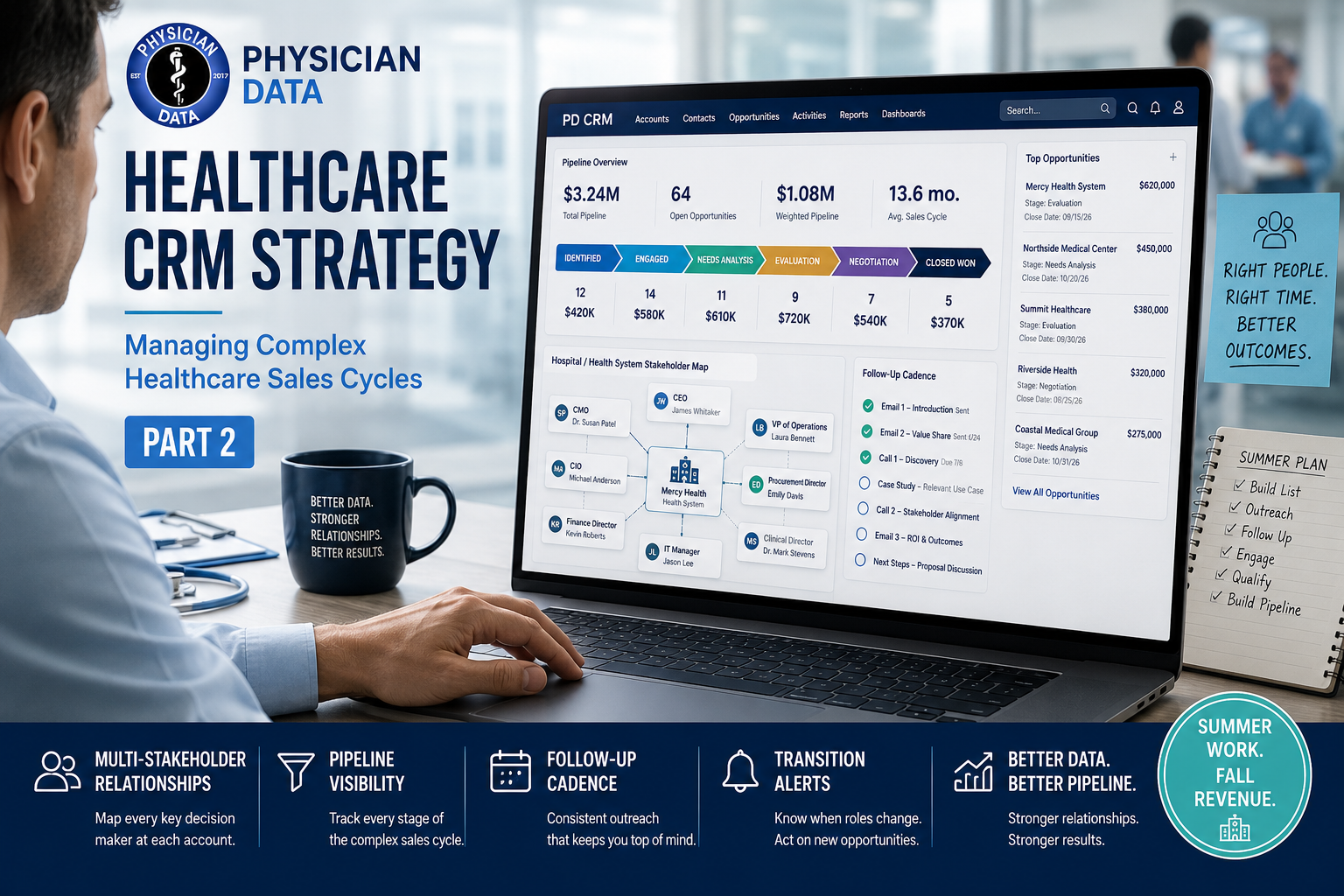
Healthcare technology purchases almost never come down to one person. The clinical sponsor is not the financial approver, who is not the IT evaluator, who is not the compliance reviewer, who is not the procurement administrator. A deal where you have a strong relationship with the CMO and no relationship with the Revenue Cycle Director, the CFO, or the IT Director is a deal at risk at every subsequent approval stage.
The physician mailing list and healthcare email list that serves multi-stakeholder healthcare sales is one that includes all of these contact types at the same health system -- not just the clinical leadership contact who is easiest to identify. A healthcare contact database that maps the CMO, the Revenue Cycle Director, the CMIO, and the CFO at the same health system account gives you a sales team rather than a single point of contact. The same multi-stakeholder mapping principle applies in government purchasing, as Civic Data has documented in its research on GovTech buying committees, and in K-12 education, where K12 Data has documented how EdTech buying committees now span safety, HR, wellness, and technology leadership.
The most common CRM mistake in healthcare sales is creating separate records for every contact rather than mapping multiple contacts to the same health system or physician group account. When the CMO is in one record and the Revenue Cycle Director is in another with no connection, you have no view of your relationship with the organization as a whole. You cannot see that you have reached the CMO three times and never contacted the Revenue Cycle Director. Organize around accounts first. Contacts second.
A cardiologist in an independent practice, a cardiologist at a PE-affiliated group, and a cardiologist at a large health system are three completely different sales contexts with different purchasing processes, different budget authority, and different decision timelines. Your physician mailing list and CRM need to capture which organizational context each contact is operating in -- because the sales motion for each is different and treating them the same produces results that work for none of them.
In healthcare, transition events are purchasing events. A physician who just left a PE-backed group and is establishing an independent practice is evaluating every vendor from a clean position. A new CMO is building their vendor roster. An FQHC that just absorbed patients from a rural hospital closure is in urgent purchasing mode. These events are the highest-urgency windows in the healthcare market and they require a CRM that flags them when they occur.
Healthcare administrators are skeptical of vendor outreach by default. They have been sold transformational solutions that transformed nothing. The follow-up approach that works adds value with every contact rather than adding volume.
• Follow-up one, two weeks out: a specific piece of relevant information. A regulatory development they are managing. A case study from a peer health system. A data point about the clinical challenge you discussed. Not a reminder. Something worth reading.
• Follow-up two, four weeks out: a genuine question about how they are approaching something you know they are dealing with. "How is your team managing the CMS prior authorization timeline?" Genuine questions get genuine responses in a way that standard follow-up sequences do not.
• Follow-up three, six to eight weeks out: direct and respectful. "I have reached out a couple of times and want to make sure I am not being a nuisance. If this is not the right time or fit, just say so and I will check back when it makes more sense." This almost always produces a response -- either an interest signal or a clear "not now" that lets you stop following up and focus elsewhere.
A physician mailing list or healthcare email list compiled before 2022 is missing roles that control meaningful budgets in 2026. Metabolic Health Directors and GLP-1 Program Coordinators. Chief Wellness Officers. Clinical AI Directors. FQHC Executive Directors in rural closure markets. These are not niche roles. They are primary buyers for the fastest-growing clinical technology categories and they are almost certainly absent from your current doctor email lists and medical mailing lists.
The most useful segmentation in a physician contact database for 2026 is not specialty. It is organizational context and purchasing authority profile. Independent practices, PE-affiliated groups, health system-employed physicians, FQHC leadership, and rural health clinic administrators each represent different purchasing processes with different decision timelines and different approval chains. Campaigns segmented by organizational context produce dramatically better results than those treating all healthcare contacts as one audience.
Cross-reference the healthcare market with the school-based mental health and clinical workforce shortage markets. K12 Data's school mailing lists reach the K-12 side of the shared clinical workforce shortage market. College Data's college mailing lists reach the higher education side through healthcare workforce credential programs. Civic Data's government mailing lists reach state Medicaid officials and rural health directors whose decisions shape the operating environment for FQHCs and rural health clinics. Vendors with contact data spanning all three sectors reach the full healthcare delivery and workforce ecosystem.
In healthcare, the metric that corresponds to closed deals is not response rate. It is meeting-to-next-step conversion. A healthcare administrator who replies to your email is not a deal. One who takes a call and agrees to bring in two other stakeholders for a follow-up is a deal in development. Track meeting advancement rate. If meetings are not advancing, the problem is what happens inside them. If you are not booking meetings, the problem is the list or the message. Knowing which determines the solution.
Part 1 covered summer outreach strategy, email fundamentals, and physician mailing list hygiene. This is Part 2. The same framework runs for K-12 at K12 Data, for higher education at College Data, and for government at Civic Data.
K12 Data -- Build a List | Pricing | Blog College Data -- Build a List | Pricing | Blog Physician Data -- Build a List | Blog Civic Data -- Build a List | Blog




 0
0
POST A COMMENT