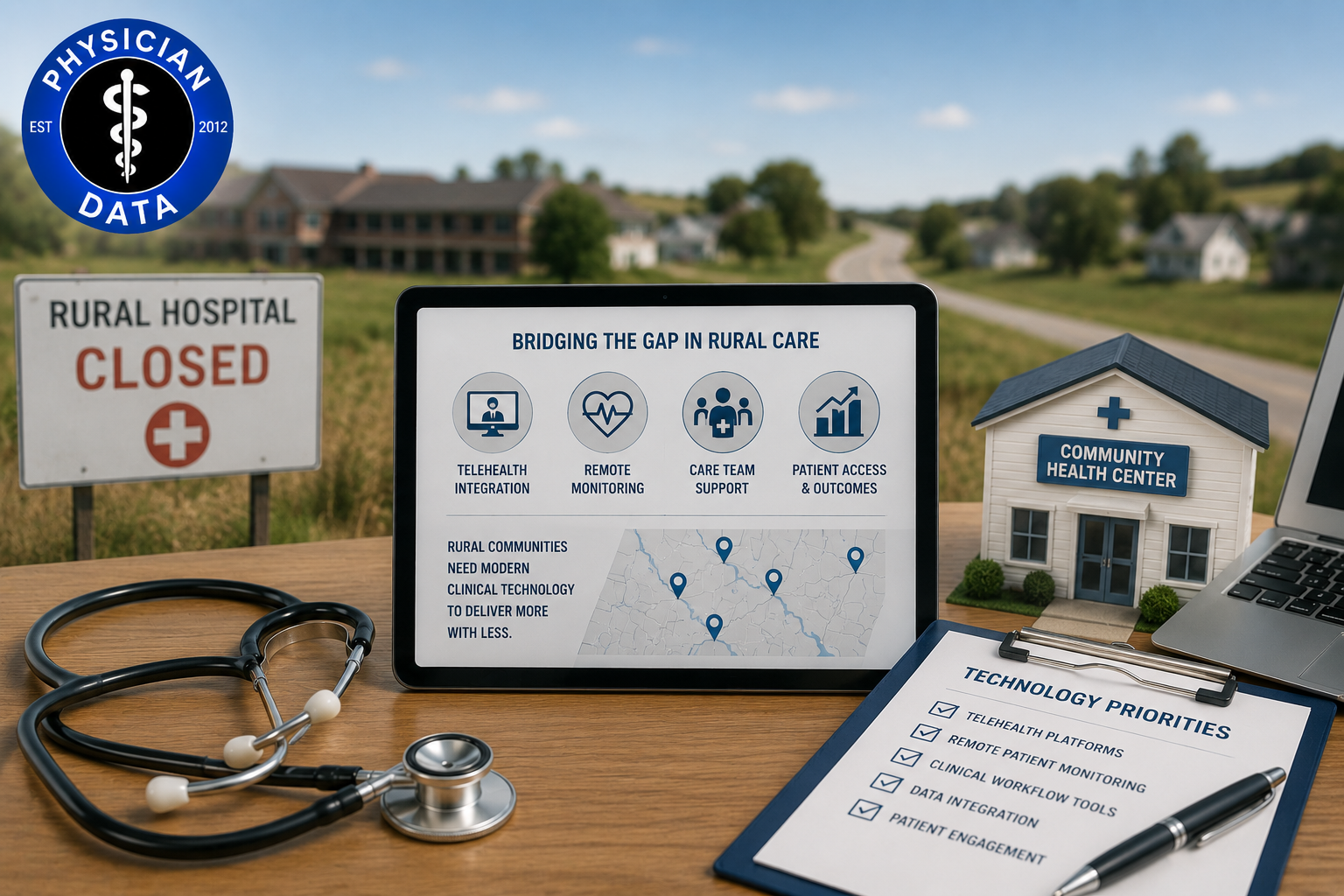


More than 180 rural hospitals have closed since 2010. Another 600 or more are considered financially vulnerable by healthcare analysts tracking rural facility viability. The coverage of this crisis has been extensive -- the communities losing access to emergency care, the economic impact of a major employer leaving a small town, the policy debates about rural healthcare funding and reimbursement rates. What the coverage has consistently missed is what happens next, specifically to the patients, the clinical staff, and in some cases the physical infrastructure that a closed rural hospital leaves behind.
What happens next is that federally qualified health centers, rural health clinics, and critical access hospitals absorb those patients -- often managing a volume and complexity of care they were not originally designed or resourced to handle, with technology systems that predate meaningful digital health investment, and with clinical staff working under resource constraints that make administrative burden proportionally more damaging than it would be at a larger, better-resourced facility. These organizations are in active and urgent technology evaluation right now. They are purchasing telehealth integration, remote monitoring, clinical workflow tools, and the population health infrastructure that makes managing a geographically dispersed, high-acuity patient population operationally sustainable. And almost no physician mailing list in the market has mapped them as a distinct purchasing tier with its own contact structure, its own decision-making timeline, and its own funding channel.
Federally Qualified Health Centers are the primary institutional response to rural hospital closure from the federal government's perspective. FQHCs receive federal grant funding through Health Resources and Services Administration Section 330 grants, serve patients regardless of ability to pay, and must meet specific federal quality and reporting requirements in exchange for their grant funding and enhanced Medicaid and Medicare reimbursement rates. There are more than 1,400 FQHC organizations operating more than 15,000 service delivery sites across the country, serving approximately 30 million patients annually -- a number that has been growing as rural hospital closures have expanded the population without local hospital access.
FQHCs are required by their federal grant conditions to implement and maintain specific health IT infrastructure, including electronic health records certified to federal standards, quality reporting systems that capture the clinical performance metrics HRSA uses to evaluate grant performance, and increasingly the telehealth and remote monitoring infrastructure that allows them to serve patients who cannot easily travel to a clinic site. This federal mandate creates purchasing urgency that is tied to grant compliance rather than to the standard commercial purchasing calendar -- an FQHC that receives a new HRSA grant award has implementation timelines and technology requirements attached to that award that create immediate purchasing decisions.
Critical access hospitals are small rural hospitals that qualify for a special Medicare reimbursement methodology -- cost-based reimbursement rather than the standard prospective payment system -- in exchange for maintaining emergency services and meeting specific bed count and geographic requirements. There are approximately 1,350 critical access hospitals operating across the country, and they serve as the only inpatient hospital within a meaningful geographic radius for large portions of rural America. Critical access hospitals that are not themselves at closure risk are frequently the receiving institutions for patients from facilities that have closed, expanding their effective patient panel without a proportional expansion in staffing or technology resources.
The technology purchasing at critical access hospitals is driven by a combination of the standard rural healthcare resource constraint dynamic and the specific federal reporting and quality requirements attached to critical access hospital designation. Telehealth infrastructure, remote specialist consultation platforms, and the clinical data integration tools that allow a small rural facility to function as a hub for a geographically dispersed care network are purchasing priorities that most physician mailing lists have not mapped to this specific organizational category.
The rural healthcare technology vacuum connects directly to the telehealth and hybrid care purchasing dynamic documented in Physician Data's research on the permanent restructuring of the patient-physician relationship. The same asynchronous care platforms, remote monitoring integration tools, and digital front door technology that urban and suburban health systems are purchasing as enhancements to an existing care model are, for rural FQHCs and critical access hospitals, the core clinical infrastructure that makes a safe, effective care model operationally possible at all given their geographic and staffing constraints.
Understanding why this purchasing is happening urgently right now requires understanding the federal funding channels that have been specifically directed at rural healthcare technology infrastructure in recent years. The Federal Communications Commission's Healthcare Connect Fund and the Rural Health Care Program have channeled hundreds of millions of dollars toward rural healthcare broadband and telehealth infrastructure. HRSA has expanded its telehealth-specific grant programs for FQHCs. And the Infrastructure Investment and Jobs Act included significant funding for rural broadband expansion that is a prerequisite for meaningful telehealth deployment in the areas where rural hospitals have closed.
These funding streams create purchasing urgency on a grant-compliance calendar that is entirely separate from the standard commercial healthcare purchasing cycle. An FQHC that received a new telehealth infrastructure grant six months ago is in active implementation mode right now, making real-time decisions about platform selection, vendor relationships, and the clinical workflow integration that makes the funded technology operationally effective rather than just technically deployed.
The government funding channel parallel is directly relevant here. The same HRSA grant dynamics that drive FQHC technology purchasing parallel the infrastructure grant dynamics documented in Civic Data's research on how Infrastructure Law money is creating new local government technology buyers. In both cases, federal grant funding creates a purchasing urgency timeline that has nothing to do with the standard commercial calendar, and vendors who understand the grant compliance requirements attached to the funding are reaching buyers at precisely the moment they are most motivated to move quickly on a technology decision.
The purchasing decision-makers for clinical technology at FQHCs and critical access hospitals are not the same contacts that drive technology purchasing at large health systems or urban physician practices. At an FQHC, the Chief Medical Officer and the Chief Information Officer are often the same person, or are two roles at an organization where the combined staff managing clinical and technology decisions numbers in the single digits. The Medical Director at a rural health clinic evaluating a telehealth platform is frequently evaluating it simultaneously as the clinical quality authority, the budget holder, the grant compliance officer, and the primary end user -- a concentration of decision-making authority that means the sales cycle, once a vendor has found the right contact, can move considerably faster than at larger, more bureaucratically complex healthcare organizations.
At the FQHC organizational level, the Medical Director or Chief Medical Officer is frequently the primary decision-maker for clinical technology that affects care delivery -- telehealth platforms, remote monitoring systems, and the population health tools that manage the FQHC's high-complexity, Medicaid-heavy patient population. Most physician contact databases that map CMO contacts at health systems and large group practices have not extended that mapping to the FQHC sector with equivalent depth.
FQHCs are required to maintain certified electronic health record technology and to report clinical quality data through specific health IT channels as conditions of their federal grant funding. The Health IT Director or CIO managing this compliance infrastructure is a technology purchasing contact with real authority over platform selection, integration decisions, and the vendor relationships that determine whether an FQHC's technology stack meets its federal reporting obligations.
A meaningful and growing share of rural healthcare delivery is organized through formal rural health networks -- collaborative arrangements between FQHCs, critical access hospitals, rural health clinics, and sometimes larger health systems that allow smaller organizations to share clinical resources, technology infrastructure, and administrative functions. The coordinator of a rural health network is a multiplying purchasing contact whose technology decisions affect every member organization in the network simultaneously.
The staffing dimension of rural healthcare technology connects to the K-12 workforce parallel documented in K12 Data's research on the Title I funding channel and the contacts controlling it. Rural FQHCs and rural school districts share a structural challenge: they are serving high-need populations with constrained resources in geographic markets that are genuinely difficult to staff. The technology that helps a small clinical team manage a large, geographically dispersed patient population serves the same function as the technology helping a rural district manage its teacher pipeline -- and the workforce dimension of the FQHC staffing challenge has created a connection to healthcare education and credentialing programs documented in College Data's research on micro-credential stacking and healthcare workforce pathways.
• Add FQHC Medical Director, FQHC Health IT Director, and Rural Health Network Coordinator as distinct contact categories in your physician mailing list -- these are different roles from large health system contacts and require different outreach positioning.
• Segment by HRSA grant award status and recency. FQHCs with new or recently expanded Section 330 grants are in the most active technology implementation mode, with compliance timelines driving purchasing urgency independent of the standard commercial calendar.
• Map critical access hospital technology directors in rural markets adjacent to recent hospital closures as the highest-urgency targets for capacity-expansion technology, since these are the facilities most directly absorbing displaced patient populations.
• Build outreach messaging around the federal compliance requirements attached to FQHC and critical access hospital designation, since a vendor who demonstrates knowledge of HRSA reporting requirements and Medicare cost-reporting obligations is differentiating from the majority of vendor outreach that treats rural healthcare organizations identically to urban practices.
Rural hospital closures are not creating a vacuum that stays empty. They are creating a transfer of clinical responsibility to federally qualified health centers, rural health clinics, and critical access hospitals that are absorbing patients, expanding their care mandate, and purchasing the clinical technology that makes their expanded mandate operationally viable. This purchasing is funded through specific federal channels, driven by specific compliance timelines, and decided by contacts that most physician mailing lists have never specifically mapped. The vendors who find and reach FQHC Medical Directors, rural health network coordinators, and critical access hospital technology leadership are entering a purchasing market that their competitors have systematically overlooked, at a moment when the rural healthcare technology vacuum created by more than a decade of hospital closures is generating real and urgent demand.
K12 Data -- Build a List | Pricing | Blog College Data -- Build a List | Pricing | Blog Physician Data -- Build a List | Blog Civic Data -- Build a List | Blog K12 Talent -- Post a Job | Search Jobs | Blog




 0
0
POST A COMMENT