

By Charles Isham, Founder, Physician Data | physician-data.com
The market for physician contact databases and healthcare marketing lists is one of the most competitive and most inconsistent in B2B data. Dozens of providers offer a doctor email list, a physician email list, or a medical mailing list with nearly identical marketing claims. The difference in quality between the best and worst providers in this market is enormous, and buying the wrong one is not just a budget waste. It is a deliverability problem that can take months to recover from.
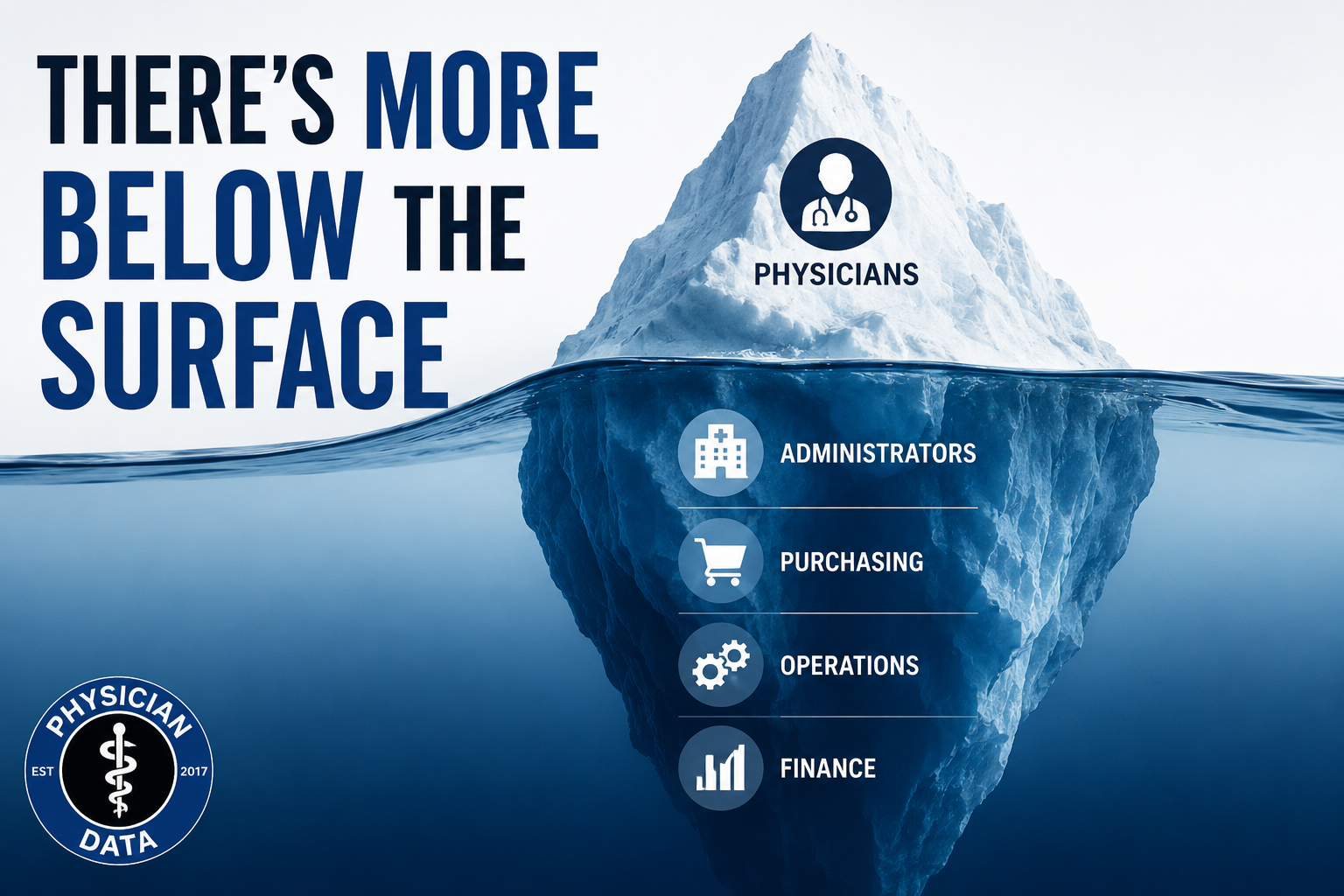
Physician consolidation has added an additional layer of complexity. A physician contact database accurate before the consolidation wave of the past five years may have records pointing to physicians whose purchasing authority has migrated to a health system or MSO, email addresses tied to dissolved practice domains, and an absence of the healthcare administrator contacts that now hold purchasing authority for many product categories.
This guide covers what a quality healthcare contact database looks like in a consolidated market, how to evaluate a physician email list or doctor email list before purchasing, and what Physician Data does differently to maintain accuracy across both the clinical and administrative layers of the current healthcare market.
A complete physician contact database for B2B marketing in 2026 must cover two fundamentally different layers of the healthcare market. The clinical layer contains individual physician records: name, specialty, NPI number, practice setting, email address, phone, and geographic information. This is the traditional physician email list that most healthcare data providers focus on. It is necessary for campaigns where clinical preference is the primary purchasing driver, particularly in medical device, pharmaceutical, and clinical software categories.
The administrative layer contains healthcare administrator contacts at the health system, MSO, and large group practice level: VP of Supply Chain, Director of Procurement, Chief Medical Officer, VP of Operations, and the growing category of MSO executive roles created by private equity consolidation. This layer is necessary for campaigns where the purchasing decision sits above the physician level, which in a consolidated market means the majority of categories by dollar value. A physician database covering only the clinical layer is missing the decision-makers who approve the majority of significant healthcare purchases.
The doctor email list market has a specific verification problem that does not exist in most other B2B contact data markets. Physicians frequently have multiple professional email addresses: one at their primary employer, one at the hospital where they have admitting privileges, and sometimes one at a medical school. A doctor email list capturing only one address may be technically accurate but may not capture the address the physician actually monitors for professional communications.
Physician consolidation has created a wave of email address changes as independent practitioners move to employed settings with institutional email domains. A physician who had a personal practice email now has a health system address. Legacy physician databases that have not tracked this transition continue to show the old practice email, which may have been deactivated or may route to a general inbox no one monitors.
Physician Data addresses these verification challenges through a multi-source approach combining NPI database cross-referencing, direct institutional website review, and continuous monitoring of employment change signals, resulting in a physician email list that reflects current employment status and current institutional email addresses.
Healthcare administrator contacts have become the highest-priority segment of the healthcare contact database for many product categories. VP of Supply Chain, Director of Procurement, and MSO-level executives now control purchasing decisions that previously belonged to individual physicians. The territory management implications of this shift were covered in depth at physician-data.com/territory-management-account-prioritization-healthcare-contact-data, which describes how to build a three-tier account strategy that reaches both clinical and administrative layers.
Building a healthcare administrator contacts database that covers health system leadership and MSO-level executives requires monitoring healthcare industry news for acquisition announcements, tracking the formation and growth of PE-backed physician groups, and directly researching the organizational structure of health systems rather than relying on directory sources that do not capture these roles. Physician Data maintains healthcare administrator contacts across the full spectrum of the consolidated market.
The specialist email list is the highest-value segment of the clinical layer for most medical device and specialty pharmaceutical vendors. In specialties that have seen significant PE-backed consolidation, including dermatology, gastroenterology, and ophthalmology, the physician contacts in a specialist email list may be employed by MSO-managed groups where purchasing authority has migrated to the MSO level. A specialist email list that does not flag employment and authority status is providing incomplete information for campaign strategy.
Physician Data's specialist email list records include employment status information where available, indicating whether a specialist is in independent practice, employed by a health system, or affiliated with a PE-backed group. That context allows campaign strategists to layer the appropriate administrative contacts alongside the clinical specialist contacts for each target account.
A physician email list enables rapid, scalable, measurable digital outreach. Email campaigns to verified physician contacts produce faster pipeline activity than direct mail, are more easily personalized to specialty and practice context, and generate engagement data that informs follow-up strategy. A medical mailing list for postal outreach has seen a resurgence for a specific reason: physician inbox environments are heavily filtered, and a well-designed direct mail piece to a physician's practice address has a higher probability of being physically reviewed than the corresponding email.
For high-value medical device categories where the cost per contact justifies premium channel spend, combining a physician email list with a medical mailing list to the same targeted specialist population produces engagement rates that neither channel achieves alone. Physician Data provides both email contact records and mailing address information within the same contact database.
Healthcare vendors whose market includes government-funded programs, VA medical centers, and federally qualified health centers are operating at the intersection of healthcare and government. The government contact buyer's guide at civic-data.com/government-contact-database-buyers-guide covers how to evaluate federal agency and state public health department contacts using the same framework applied here to physician data.
For vendors selling into academic medical centers, the higher education contact universe described at college-leads.com/higher-education-contact-database-buyers-guide is directly relevant. Academic medical center administrators, department chairs, and research directors are simultaneously healthcare contacts and higher education contacts, and the best outreach strategies reach them through both data layers.
What makes a physician contact database accurate in 2026?
A physician contact database accurate in a consolidated market must cover both the clinical physician layer and the healthcare administrator contacts layer, verified at a cadence that accounts for ongoing consolidation activity. For the clinical layer, verification should confirm current employment status and current institutional email address, not just technical email deliverability. For the administrative layer, verification requires monitoring MSO formation activity, health system acquisitions, and administrative personnel changes not captured in traditional medical directories.
How do I evaluate a doctor email list before buying?
Request a sample of at least 100 records and verify a selection manually. Check whether email addresses are tied to current institutional domains or legacy practice domains that may have been dissolved. Ask specifically about the methodology for tracking physician employment changes. Ask whether the database covers healthcare administrator contacts at the health system and MSO level in addition to clinical physician contacts.
What healthcare administrator contacts should I target alongside physician contacts?
The most important healthcare administrator contacts to target alongside clinical physician contacts are VP of Supply Chain or Procurement at the health system level, Chief Medical Officer at the group or system level, VP of Operations at MSO-managed groups, and Director of Pharmacy or Formulary Management for pharmaceutical-related categories. The specific administrative contacts that matter most depend on the product category.
Is it worth buying a specialist email list separately from a general physician database?
For vendors whose products are specific to one or two medical specialties, a specialty-filtered view of a quality physician contact database is more valuable than a general physician database. Physician Data's specialist records include verified specialty information with NPI cross-referencing, making a gastroenterologist email list or a dermatologist email list pulled from the database more reliably accurate than a specialty filter applied to a general medical list.
How has physician consolidation changed what I should look for in a healthcare contact database?
Physician consolidation means a healthcare contact database adequate before 2020 is likely missing two critical things: accurate employment status for physicians who have moved from independent practice to employed settings, and the healthcare administrator contacts at the health system and MSO level who now control purchasing authority for many categories. When evaluating any physician contact database, specifically ask whether it tracks employment status changes and covers the administrative decision-maker layer in addition to clinical physician contacts.
The healthcare contact database market is evolving faster than most buyers realize. Physician consolidation has changed who makes purchasing decisions, where those decisions are made, and what contact data is required to reach the right people. A physician email list or doctor email list built for the pre-consolidation market is an increasingly poor fit for the purchasing reality of 2026.
Quality in a healthcare contact database today means covering both the clinical layer and the administrative layer, verifying both at appropriate cadences, and maintaining the employment status and authority context that allows campaign strategists to reach the right contact at the right level of the organizational hierarchy. Physician Data is built for this standard. Visit physician-data.com to explore the full database and request a sample.
K12 Data covers K-12 educator contacts with 4.1M+ verified records at k12-data.com. The same buyer's guide framework that applies to physician contact databases applies equally to educator contact databases. Read The K-12 Email List Buyer's Guide for the parallel framework applied to the K-12 market. Build a K-12 educator list at k12-data.com/build-a-list.
College Data covers higher education administrator and faculty contacts at college-leads.com. For vendors selling into both healthcare and academic medical centers, the higher education contact database buyer's guide at college-leads.com/higher-education-contact-database-buyers-guide covers how to evaluate academic medical center administrator contacts specifically. Build a higher ed list at college-leads.com/build-a-list.
Civic Data covers government and public sector contacts at civic-data.com. For healthcare vendors selling into VA hospitals, public health departments, or government-funded healthcare programs, the government contact buyer's guide at civic-data.com/government-contact-database-buyers-guide covers the federal agency and state health department contact landscape. Build a government list at civic-data.com/build-a-list.
Charles Isham is the founder and CEO of K12 Data, Inc. and a portfolio of B2B data platforms covering education, healthcare, and government. A U.S. veteran with more than 15 years in education data, he oversees more than 5 million verified contacts across K-20 education, healthcare, and public-sector verticals. Reach him at Charlie@k12-data.com. Learn more at physician-data.com.




 0
0
POST A COMMENT