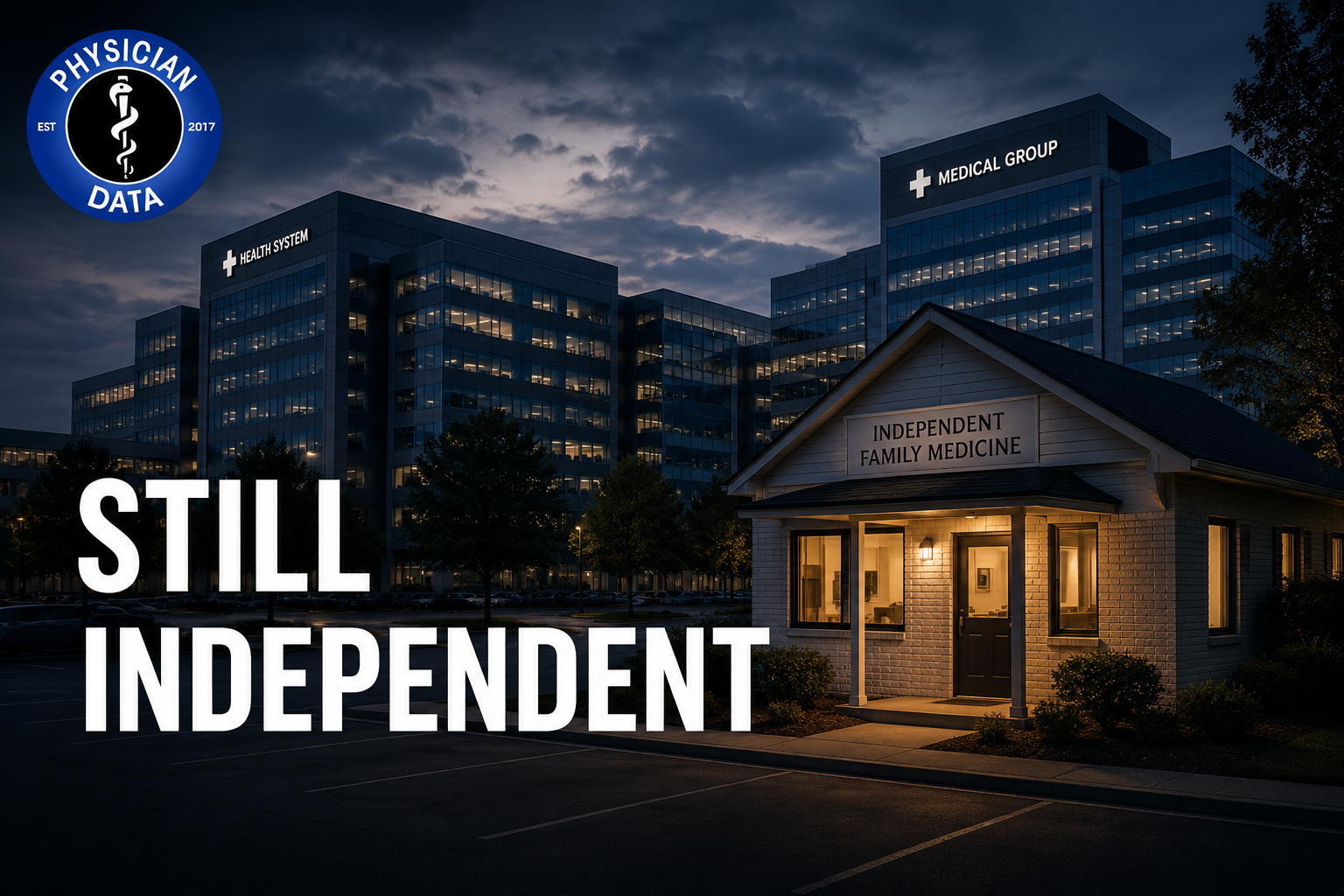


Fifteen years ago, roughly 60 percent of practicing physicians in the United States owned their own practice or were partners in a physician-owned group. Today that number is under 30 percent. The American Medical Association's most recent practice benchmark survey confirms what every physician in independent practice already knows from lived experience: the structural forces pushing toward employment and consolidation have not slowed down, and the independent practice model that defined American medicine for most of the twentieth century is on a trajectory toward becoming a minority arrangement within the current decade.
The drivers of this consolidation are well documented. Reimbursement rates from both government and commercial payers have not kept pace with the cost of running a practice. Administrative burden -- prior authorization, quality reporting requirements, electronic health record compliance, billing complexity -- has grown to a scale that small independent practices struggle to manage without the back-office infrastructure that larger organizations can afford. Capital requirements for technology, facility upgrades, and the working capital to weather reimbursement delays have grown beyond what many independent practices can self-finance. Private equity and health system acquisition offers, meanwhile, have become increasingly attractive to physicians facing these pressures who see selling as the only viable path to financial security and reduced administrative burden.
What is less understood, and considerably more interesting for healthcare vendors, is that a genuine counter-trend has emerged among physicians who have made a deliberate decision to remain independent. These practices are not simply absorbing the increased administrative and financial pressure and hoping to survive. They are adopting specific technology and service categories that directly address the structural disadvantages independent practices face relative to PE-backed and health-system-employed competitors -- effectively buying back, through technology, some of the scale advantages that drove their peers toward consolidation.
The decision to remain independent in 2026 is rarely a passive default. It is, at practices that are genuinely thriving as independents, an active strategic choice made by physicians who have specifically evaluated the tradeoffs and concluded that independence -- with the right technology and service infrastructure -- produces better clinical and financial outcomes than employment or PE-backed consolidation.
The clinical autonomy argument remains powerful for many physicians, particularly in specialties where PE-backed consolidation has produced documented changes in clinical decision-making influenced by financial targets rather than purely clinical judgment. Physicians who have practiced under both models frequently report that independent practice preserves a decision-making autonomy that employed and PE-affiliated practice does not, and that this autonomy is professionally and personally valuable enough to justify the additional administrative burden independence requires.
The financial argument has also shifted in a way that favors independence more than it did five years ago, for practices that adopt the right technology stack. The administrative burden that drove many physicians toward consolidation can now be substantially outsourced rather than absorbed internally -- which means the core argument for selling to a health system or PE-backed group (access to back-office scale and administrative infrastructure) can be replicated through vendor relationships rather than ownership transfer.
Revenue cycle management -- the billing, coding, claims submission, denial management, and collections functions that determine whether a practice actually gets paid for the care it delivers -- has historically required either a substantial internal billing staff or acceptance of the inefficiencies that come from undertrained or under-resourced billing operations. Outsourced revenue cycle management platforms and services have matured significantly, now offering independent practices access to denial management sophistication, prior authorization automation, and claims optimization technology that previously only large health systems and PE-backed groups could afford to build internally.
A solo or small-group independent practice using a modern outsourced revenue cycle platform can achieve clean claim rates and denial recovery performance that rivals much larger organizations, without the capital investment or staffing complexity of building that capability internally. This is one of the most significant technology categories enabling the independence counter-trend, because revenue cycle performance is frequently the single largest financial differentiator between a struggling independent practice and a thriving one.
The prior authorization automation dimension of revenue cycle technology connects directly to the broader purchasing wave documented in Physician Data's research on the prior authorization crisis. Independent practices face the same 56 percent increase in denial rates and 14-hours-per-week administrative burden documented in that research -- but they face it without the dedicated revenue cycle staff that larger organizations can deploy, which makes outsourced automation technology proportionally more valuable to an independent practice's survival than to a health system's incremental efficiency.
Group purchasing organizations -- cooperative purchasing arrangements that allow independent practices to access the volume-based pricing on medical supplies, pharmaceuticals, and equipment that large health systems negotiate through their purchasing scale -- have existed for decades but have become significantly more sophisticated and more essential to independent practice economics as input costs have risen. Modern GPO platforms aggregate the purchasing volume of thousands of independent practices to negotiate pricing that approaches health system rates, directly neutralizing one of the most commonly cited financial advantages of consolidation.
Independent practices that have joined well-structured group purchasing cooperatives report supply and equipment cost reductions of 15 to 30 percent relative to practices purchasing independently at list price -- a margin improvement that can be the difference between a practice that struggles financially and one that comfortably sustains independence.
Beyond revenue cycle and purchasing, a growing category of shared services platforms provides independent practices with access to human resources administration, compliance management, IT support, and the credentialing and licensing management infrastructure that consolidated organizations build internally and that independent practices have historically had to manage with inadequate internal resources or expensive individual vendor relationships. These platforms allow a five-physician independent practice to access HR and compliance infrastructure quality that approaches what a 200-physician health-system-affiliated group can provide internally, at a cost structure that scales with practice size rather than requiring the fixed overhead of internal staff.
Quality reporting requirements under value-based care arrangements and MIPS reporting have become a significant administrative burden that independent practices have historically struggled to manage without dedicated quality reporting staff. Clinical decision support and automated quality reporting platforms that integrate with practice EHR systems to track quality measures, automate reporting submission, and identify clinical care gaps before they affect quality scores are reducing the administrative burden differential between independent practices and larger organizations with dedicated quality teams.
The independent physician practice owner evaluating whether to remain independent or accept a consolidation offer is one of the highest-value and most time-sensitive purchasing contacts in the healthcare technology market. A physician owner who has decided to fight for independence and is actively building the technology stack that makes that decision financially viable is in active evaluation across multiple vendor categories simultaneously -- revenue cycle, group purchasing, shared services, and quality reporting -- often within a compressed decision window driven by an acquisition offer deadline or a specific financial crisis that forced the independence-versus-consolidation question to a head.
At independent practices large enough to have a dedicated administrative leader, the Practice Administrator or Office Manager is frequently the primary evaluator for revenue cycle, group purchasing, and back-office technology decisions, with the physician owner providing final approval. This contact is managing the day-to-day operational reality of running an independent practice against larger competitors and is highly motivated to find technology solutions that close the resource gap.
Independent Practice Associations and clinically integrated networks -- organizational structures that allow independent practices to collaborate on payer contracting, shared quality reporting, and group purchasing while maintaining individual practice ownership -- are an increasingly important purchasing layer above the individual practice. The administrators leading these organizations are purchasing technology platforms that serve their entire network of affiliated independent practices simultaneously, representing a purchasing decision that affects dozens or hundreds of practices through a single vendor relationship.
The healthcare workforce dimension of independent practice survival connects to the broader clinical staffing market documented in Physician Data's research on rural hospital closures and FQHC purchasing. Independent practices in rural and underserved markets face the most acute version of the consolidation pressure documented in this research, and the technology that helps them remain viable is frequently the difference between a community retaining local independent physician access and that access disappearing into a regional health system that may not maintain the same local presence.
• Segment your physician mailing list by practice ownership structure and recent acquisition offer exposure. Independent practices that have recently received or rejected a consolidation offer are in the highest-urgency window for the technology investments that support continued independence.
• Include Practice Administrators and Office Managers as distinct, high-priority contacts for revenue cycle, group purchasing, and back-office technology categories, not just physician owners.
• Map Independent Practice Association and clinically integrated network leadership as a multiplying purchasing contact -- a single relationship with network leadership can represent purchasing influence across dozens of affiliated independent practices.
• Track group purchasing cooperative membership as a market signal. Practices that have recently joined a GPO are demonstrating active investment in the independence-supporting technology stack and are likely candidates for adjacent revenue cycle and back-office service categories.
• Prioritize rural and underserved market independent practices, where the consolidation pressure is most acute and where the technology investment decision frequently has the most significant community healthcare access implications.
The decline of independent physician practice ownership from 60 percent to under 30 percent over fifteen years is a real and ongoing structural trend that is not reversing. But within that broader trend, a genuine and growing counter-movement of physicians choosing deliberate independence, supported by a maturing technology stack that neutralizes many of the scale advantages that drove their peers toward consolidation, represents a healthcare vendor market that most physician mailing lists have not mapped with the urgency and specificity it deserves.
The vendors whose physician contact databases identify practices in active stay-independent decision mode -- and that reach physician owners, practice administrators, and IPA leadership with the revenue cycle, group purchasing, and back-office technology that makes independence financially viable -- are serving a market with genuine urgency, genuine financial stakes, and a meaningful role in determining whether independent medicine survives as a viable practice model in American healthcare.
K12 Data -- Build a List | Pricing | Blog College Data -- Build a List | Pricing | Blog Physician Data -- Build a List | Blog Civic Data -- Build a List | Blog K12 Talent -- Post a Job | Search Jobs | Blog




 0
0
POST A COMMENT