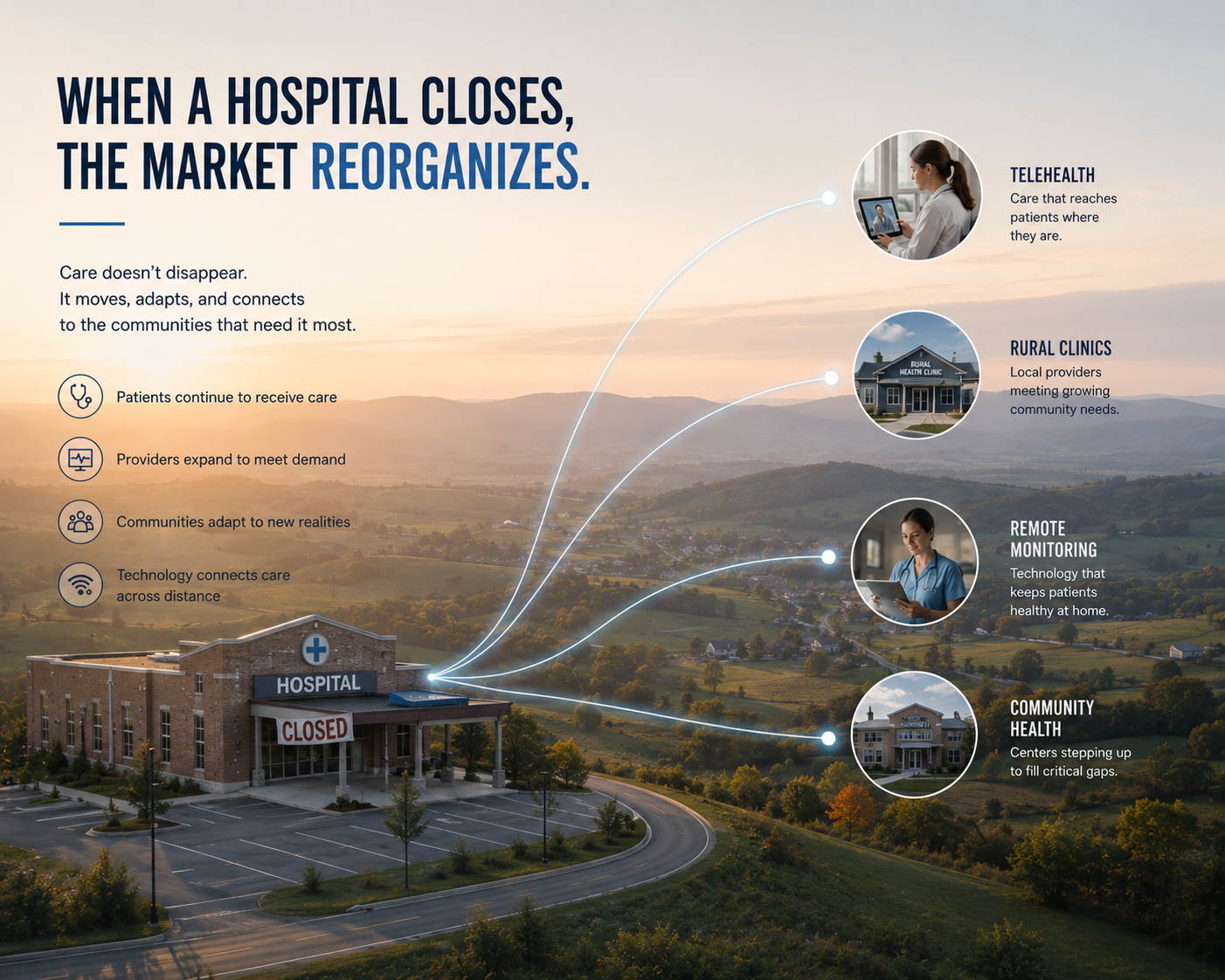


Imagine a town of 8,000 people that loses its only hospital. It does not just lose an emergency room. It loses the primary care clinic attached to the hospital. It loses the lab where residents get their blood drawn. It loses the imaging center where the local doctor sends patients for X-rays. It loses the physical therapy services, the outpatient surgery suite, and often the one or two specialists who maintained offices there because the hospital provided the referral base they needed.
What fills the gap is not nothing. It is a set of smaller, leaner, and usually under-resourced providers who suddenly have to serve a population they were not built for. Federally qualified health centers that were already at capacity. Rural health clinics with two physicians and a physician assistant. Critical access hospitals 40 miles away that are now seeing significantly more patients than they were designed to handle. And a growing number of telehealth providers filling in for in-person care that the closure made impossible to deliver locally.
This is the reality in an increasing number of communities across the United States. The Center for Healthcare Quality and Payment Reform has identified more than 700 rural hospitals currently at risk of closure. Nineteen rural hospitals closed in 2023 alone. The financial pressures driving the closures -- low Medicare and Medicaid reimbursement rates, a patient population with high chronic disease burden and limited ability to pay, difficulty recruiting physicians to rural markets, and the rising cost of maintaining aging facilities -- have not improved.
For healthcare vendors, the rural hospital closure wave is not just a sad story. It is one of the largest unmapped purchasing opportunities in the healthcare technology market. The organizations absorbing displaced patients are buying clinical technology on urgent timelines with a specific set of needs that most physician mailing lists and healthcare email lists were not designed to identify or reach.
Rural hospital closures do not happen cleanly. There is rarely a single day when the doors shut and everything reorganizes neatly around the remaining providers. What usually happens is a gradual deterioration that accelerates: services get cut, staff leave to find more stable employment, patient volumes drop as residents seek care elsewhere, revenue declines further, and eventually the institution reaches the point where closure is inevitable.
By the time a rural hospital closes, the surrounding community has usually already begun to adapt. FQHCs have hired additional staff. Rural health clinics have extended hours. The critical access hospital in the county seat has added capacity. But the closure accelerates these adaptations and pushes them past what the surviving organizations had planned for.
The purchasing that follows a closure is driven by necessity and urgency. An FQHC that suddenly needs to serve 3,000 additional patients who lost their primary care access when the hospital's affiliated clinic closed does not have months to evaluate technology options through a standard procurement process. They need telehealth infrastructure now. They need remote monitoring tools that let a small clinical staff manage a larger patient panel safely. They need the clinical decision support systems that help a physician assistant make safe decisions for complex patients who previously had access to specialist consultation through the hospital's referral network.
The financial dimension of this urgency is significant. FQHCs receive federal grant funding through the Health Resources and Services Administration that is tied to the patient population they serve. When a rural hospital closes and an FQHC absorbs a significant number of displaced patients, the FQHC may be eligible for additional funding to expand its capacity. But that funding comes with compliance requirements and reporting obligations that require administrative technology and data infrastructure. The government funding dynamics documented in Civic Data's research on how federal program devolution is creating state and local purchasing urgency are directly relevant here -- in both cases, federal funding creates both the capacity and the compliance obligation to purchase specific technology, and the purchasing urgency is driven by grant timelines rather than standard procurement cycles.
The Executive Director and Medical Director of a federally qualified health center that has absorbed significant patient volume from a rural hospital closure are some of the most urgently purchasing healthcare contacts in the country. They are managing patient volume increases that their current infrastructure was not designed for, often with limited staff and a facility that needs to be expanded or upgraded to meet the new demand. They are purchasing telehealth platforms, remote monitoring technology, EHR upgrades that support higher patient volumes, and the clinical decision support tools that help their teams manage a patient population with more complexity than they were previously serving. Most physician mailing lists include FQHCs as a contact category, but most do not include FQHC Executive Director and Medical Director as distinct, high-priority contacts with the purchasing urgency that post-closure absorption creates.
Rural health clinics -- smaller outpatient facilities that serve Medicare and Medicaid patients in rural areas -- are often the first organizations to absorb patients when a rural hospital closes its affiliated outpatient services. The administrators and medical directors of these clinics are making purchasing decisions for technology that extends their clinical reach without requiring the staff additions they cannot afford. Telehealth infrastructure. Remote patient monitoring. Clinical decision support. The patient communication platforms that help a small team stay connected with a dispersed rural patient population. These are genuine purchasing priorities at rural health clinics in closure-impacted markets, and they are made by administrators and medical directors that most healthcare email lists have not segmented as distinct, high-priority contacts.
Critical access hospitals -- the small rural hospitals that have received a specific Medicare designation allowing them to receive cost-based reimbursement rather than standard DRG payments -- are often the last standing hospital in a rural market after a non-critical-access facility closes. The CEO and CMO of a critical access hospital that has seen its patient volume increase significantly after a neighboring closure are managing growth that their facility was not designed for, in a regulatory environment that creates specific compliance requirements for how they deliver care. They are purchasing technology that extends their clinical capacity -- telehealth for specialist consultations, remote monitoring for high-risk patients who are difficult to transport, and the care coordination platforms that manage complex patients across a service area that just got larger.
Many rural hospitals that close do so as part of a process that ends in acquisition by or affiliation with a regional health system. The administrators managing these affiliations -- Rural Health Network Directors, regional health system executives responsible for rural market strategy -- are making purchasing decisions for the technology that connects the acquired or affiliated rural facility to the health system's clinical and administrative infrastructure. EHR integration. Telehealth network access. Shared services platforms. These are significant technology purchasing conversations driven by contacts that most physician mailing lists do not map as rural healthcare purchasing authorities.
Telehealth and virtual care platforms are the most urgent purchasing category in rural closure markets. When a rural hospital closes and the specialists who maintained practices there leave, the patients who previously had access to cardiology, orthopedics, behavioral health, and other specialty services locally are left without options unless telehealth fills the gap. FQHCs and rural health clinics absorbing these patients are purchasing telehealth infrastructure with genuine urgency -- not as an enhancement to an existing care model but as a replacement for services their patients used to access in person.
Remote patient monitoring platforms are a high priority for the small clinical teams managing large and complex patient panels after rural hospital closures. A physician assistant who is the primary care provider for 1,500 patients -- a number that may have increased significantly after a closure -- cannot safely monitor high-risk patients through quarterly in-person visits alone. Remote monitoring technology that alerts clinicians when a patient with heart failure is retaining fluid, or when a diabetic patient's blood sugar control is deteriorating, is a clinical safety tool that these teams purchase out of necessity.
Clinical decision support and specialist consultation technology fills the gap left when specialist access disappears with a rural hospital closure. In markets where the closing hospital was the only facility with a cardiologist or an oncologist, primary care providers at FQHCs and rural health clinics suddenly need better decision support for conditions they previously referred to specialists. AI-assisted diagnostic tools, evidence-based clinical guidance platforms, and the telehealth specialist consultation networks that connect rural primary care providers to specialists at academic medical centers are all in active evaluation in closure-impacted markets. The technology filling these gaps is similar in function to what Physician Data's research on the prior authorization crisis and clinical decision support needs documented -- in both markets, the administrative and clinical complexity of managing patients without adequate specialist access is driving demand for technology that helps primary care providers make safer decisions for patients who would previously have been referred.
Care coordination and population health management platforms are a purchasing priority for organizations managing geographically dispersed patient populations in rural markets. When a rural hospital closes and the community's healthcare delivery reorganizes across multiple smaller providers, no single organization has a complete picture of any individual patient's care. The care coordination technology that connects FQHCs, rural health clinics, and critical access hospitals across a shared patient population -- tracking care plans, flagging gaps in care, and facilitating communication among providers who may be serving the same patients -- is a purchasing category that most physician mailing lists have not mapped as a rural healthcare technology priority. This care coordination need is structurally similar to what K12 Data's research on how student support technology is connecting schools, families, and community resources has documented in K-12 -- in both cases, the technology that coordinates support across multiple organizations serving the same population is more valuable than any single-organization tool.
• Map FQHC Executive Directors and Medical Directors as distinct, high-priority purchasing contacts. FQHCs in rural markets that have absorbed significant patient volume from hospital closures are among the highest-urgency healthcare technology buyers in the country. Physician mailing lists that include FQHC leadership as a named, searchable contact category are delivering targeting precision that standard healthcare databases do not provide.
• Segment by rural hospital closure proximity. Healthcare contact databases that identify FQHCs, rural health clinics, and critical access hospitals within 50 miles of a rural hospital closure event in the last 24 months are identifying the organizations with the most acute post-closure absorption burden and the highest purchasing urgency. Rural hospital closure data is publicly available through the CHQPR and state health department reporting.
• Track HRSA funding announcements as purchasing urgency signals. FQHCs that have received HRSA funding increases following patient volume growth from rural hospital closures are in active technology purchasing mode using that funding. Healthcare email lists that incorporate HRSA grant status data are identifying the FQHCs with both the financial capacity and the compliance urgency to purchase quickly.
• Include Rural Health Network Directors and regional health system rural market executives. The technology purchasing that follows a rural hospital acquisition or affiliation is made at the regional health system level, not just the facility level. Physician mailing lists that include the regional executive contacts alongside the facility-level contacts are reaching the full purchasing authority for post-closure technology integration.
• Connect rural closure monitoring to physician transition tracking. When a rural hospital closes, the physicians who were affiliated with it typically transition to one of the surviving local providers, to telehealth practice, or to a regional health system. The physician transition tracking data documented in Physician Data's research on PE group fracturing and the 90-day vendor window applies here too -- the physician who just transitioned to independent or FQHC practice after a rural hospital closure is in an active vendor evaluation window for the technology that supports their new practice context.
More than 700 rural hospitals at risk of closure. Nineteen that already closed in 2023 alone. Each closure redistributes clinical authority and purchasing relationships across the surviving providers in the market in ways that most physician mailing lists cannot see because they were built to map a healthcare landscape that the closure wave is actively restructuring.
The FQHCs, rural health clinics, and critical access hospitals absorbing displaced patients are buying technology with the urgency that necessity creates, not the patience that standard procurement processes expect. The vendors whose physician mailing lists and healthcare email lists reach these organizations -- and specifically the Executive Directors, Medical Directors, and CMOs managing the post-closure absorption challenge -- are competing in a purchasing environment that their competitors have not found.
K12 Data -- Build a List | Pricing | Blog College Data -- Build a List | Pricing | Blog Physician Data -- Build a List | Blog Civic Data -- Build a List | Blog




 0
0
POST A COMMENT